
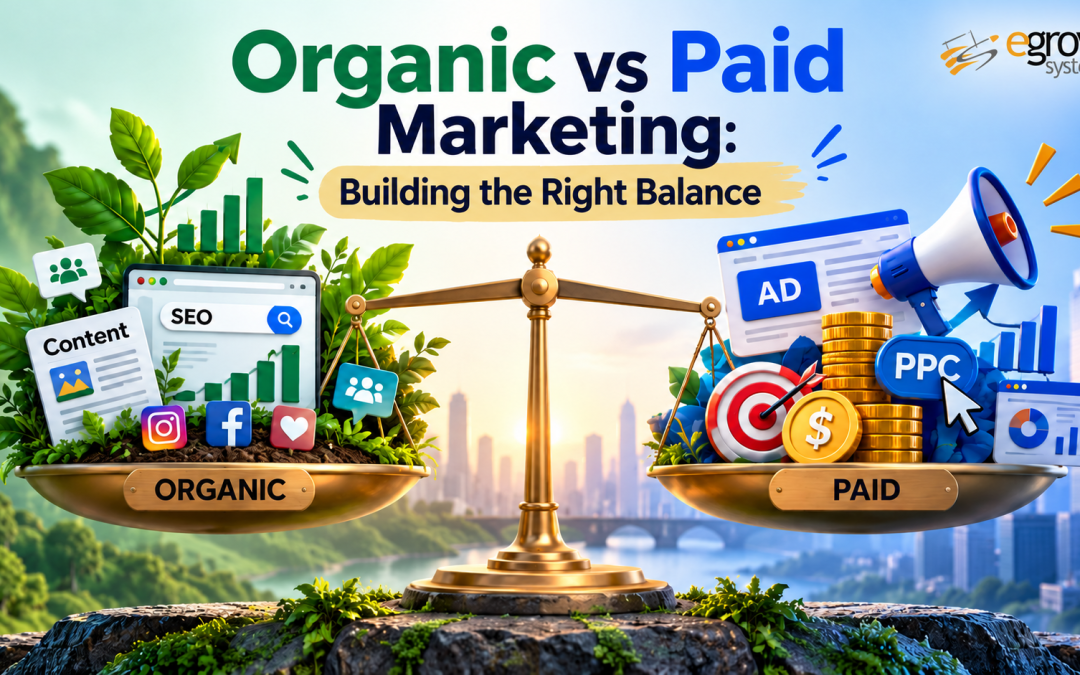
Digital marketing is often treated as a choice between organic and paid. Businesses ask whether they should invest in SEO and content or put their budget into advertising.
In reality, the strongest digital marketing services usually use both.
Organic marketing builds long-term visibility, credibility, and consistent traffic. Paid marketing provides faster exposure, targeted reach, and immediate campaign opportunities. When the two support each other, businesses can attract new audiences while building sustainable growth.
Understanding how each strategy works and when to use it is the key to getting the balance right.
What Is Organic Marketing?
Organic marketing attracts customers naturally, without paying for every click, impression, or visitor.
It usually includes:
- Search Engine Optimization (SEO)
- Blog content
- Social media posts
- Email newsletters
- Video marketing
- Local SEO and Google Business Profile optimization
- Community engagement and thought leadership
- Referral and word-of-mouth marketing
For example, when a potential customer searches Google for a solution and finds your website in an organic result, that visit is considered organic marketing.
Organic marketing generally needs more time and consistent effort, but the results can keep delivering value long after the initial work is done.
What Is Paid Marketing?
Paid marketing means spending money to place promotional content in front of a selected audience.
Common channels include:
- Google Ads
- Meta Ads
- LinkedIn Ads
- YouTube Ads
- Display advertising
- Sponsored content
- Remarketing campaigns
- Paid influencer promotions
Paid campaigns let businesses target users by location, demographics, interests, job roles, search behavior, or previous interactions with a website. Unlike organic marketing, paid advertising can generate visibility almost immediately after launch.
Organic Marketing vs. Paid Marketing
Both approaches can generate leads and sales, but they work differently.
| Factor | Organic Marketing | Paid Marketing |
| Speed | Usually takes time | Can generate immediate visibility |
| Cost | Ongoing content and optimization investment | Continuous advertising budget |
| Long-Term Value | Can keep generating traffic over time | Traffic usually drops when spending stops |
| Targeting | Driven mainly by search intent and audience engagement | Highly specific audience targeting |
| Trust | Often builds stronger credibility | Clearly promotional |
| Scalability | Growth may be gradual | Campaigns can be scaled quickly |
| Testing | Results may take longer to measure | Fast testing of messages, audiences, and offers |
Neither approach is automatically better. The right choice depends on the business objective.
Why Organic Marketing Matters
Organic marketing creates the foundation of a company’s long-term digital presence.
Quick Insight: Organic Growth Compounds Over Time
Organic marketing works like a long-term asset. A useful blog, optimized service page, or strong search presence can continue attracting visitors long after it is published. This is why consistent SEO and content efforts can reduce dependence on paid traffic over time.
Builds Sustainable Website Traffic
A well-optimized webpage or blog article can attract visitors for months or even years. Instead of paying for every click, businesses can build a library of useful content that keeps bringing relevant audiences to their website.
Builds Brand Credibility
People tend to trust businesses that consistently appear in search results, publish helpful information, and maintain an active presence across relevant channels. Educational content also lets you demonstrate expertise before asking anyone to buy.
Supports Different Stages of the Buyer Journey
Not every visitor is ready to buy immediately. Organic content can answer questions throughout the decision-making process.
- Awareness: “What is website accessibility?”
- Consideration: “Best website accessibility audit tools”
- Decision: “Website accessibility software pricing”
Creating content around these different searches keeps your business visible throughout the customer journey.
Reduces Dependence on Advertising
Businesses that rely entirely on paid advertising can see leads drop suddenly when campaigns stop. Strong organic visibility gives you another source of traffic and leads.
Why Paid Marketing Matters
Organic marketing provides long-term benefits, but paid marketing offers something equally valuable: speed.
Generates Immediate Visibility
A new business or product may take months to build strong organic rankings. Paid campaigns can put you in front of potential customers much sooner, which is especially useful for:
- Product launches
- Webinars
- Seasonal offers
- Limited-time campaigns
- New market entry
- Lead-generation campaigns
Provides Precise Audience Targeting
Paid platforms offer detailed targeting options. A B2B company, for example, may target marketing managers, agency owners, IT directors, HR professionals, or business owners, and narrow further by industry, location, interests, or online behavior.
Makes Campaign Testing Faster
Paid advertising is a quick way to test headlines, landing pages, calls to action, offers, audience segments, and creative formats. The results can later improve your organic strategy.
Supports Retargeting
Many website visitors leave without taking action. Retargeting lets you reconnect with people who visited a site, viewed a product, downloaded content, started a form, watched a video, or engaged on social media. It keeps your brand visible while prospects keep evaluating their options.
The Risk of Relying on Only One Strategy
Organic-only strategies require patience. A new website may need significant time to build authority and search visibility.
Paid-only strategies have the opposite problem: when advertising stops, much of the traffic can disappear.
A balanced approach solves both. Paid marketing creates immediate opportunities while organic marketing steadily builds a sustainable source of traffic and brand visibility.
Quick Definition: Customer Acquisition Cost (CAC)
CAC is the total cost of winning a new customer, calculated by dividing marketing and sales spend by the number of new customers gained in a given period. Tracking CAC across both organic and paid channels shows whether your mix is efficient or leaning too heavily on one side.
How Organic and Paid Marketing Can Work Together
The most effective strategies let insights from one channel improve the other.
Pro Tip: Let One Channel Improve the Other
Use paid campaigns to test headlines, offers, and audiences quickly. Then use those insights to improve SEO content, landing pages, and future campaigns. Likewise, strong organic keywords and high-performing content can guide paid advertising decisions. Pasted markdown
Use Paid Ads to Test Organic Content Ideas
Before investing heavily in a large content campaign, test different messages through paid advertising. If certain headlines or topics generate stronger engagement, use those insights to guide future blog topics, landing pages, social posts, and email campaigns.
Use SEO Data to Improve Paid Campaigns
Organic search data reveals the terms people use when looking for products or services. High-performing SEO keywords can be tested in paid search campaigns. Likewise, high-converting paid keywords deserve stronger organic optimization.
Retarget Organic Visitors
SEO and content may attract many visitors who are still researching. SEO services can help strengthen this organic visibility, while remarketing can bring them back with more focused messages, such as:
- Book a demo
- Start a free trial
- Download a guide
- Request a consultation
- Register for a webinar
Organic marketing attracts the visitor, and paid marketing helps continue the conversation.
Promote High-Performing Organic Content
If a blog post, video, or social post performs well organically, paid promotion can expand its reach. Instead of guessing which content audiences will like, put the advertising budget behind content that has already shown strong engagement.
How to Find the Right Organic and Paid Marketing Balance
There is no universal percentage that works for every company. The balance depends on several factors.
Consider Your Business Stage
A new business may need more paid marketing at first because it has little organic visibility. An established business with strong rankings may rely more on organic traffic and use paid campaigns strategically.
Consider the Sales Cycle
Products with short buying cycles may perform well with direct-response advertising. Businesses with longer B2B sales cycles often benefit from a stronger content strategy that educates prospects over time.
Consider Your Competition
Highly competitive search results may require significant SEO investment, while competitive paid keywords can become expensive. Evaluate both the organic landscape and advertising costs before deciding where to invest.
Consider Your Marketing Goals
Different goals call for different channel mixes.
| Goal | Recommended Focus |
| Immediate lead generation | Paid marketing |
| Long-term website traffic | Organic marketing |
| Product launch | Paid + organic |
| Brand awareness | Organic content + paid promotion |
| Webinar registrations | Paid campaigns + email + social |
| Industry authority | SEO + thought leadership |
| Re-engaging visitors | Paid remarketing |
A Practical Balanced Marketing Strategy
A healthy marketing program can follow a simple model.
Organic marketing: Create consistent content around customer questions and high-value keywords. Focus on SEO, AEO GEO ranking, educational blogs, case studies, social media, email nurturing, video content, and industry insights.
Paid marketing: Use advertising where speed and targeting matter. Focus on high-intent search ads, lead-generation campaigns, retargeting, product launches, webinar promotion, and content that is already performing well.
Measurement: Track how the channels influence each other instead of judging them in isolation. Useful metrics include organic traffic, keyword rankings, cost per click, cost per lead, conversion rate, customer acquisition cost, return on ad spend, marketing-qualified leads, and assisted conversions. A coordinated digital marketing strategy makes it easier to compare channels side by side and adjust the mix as results come in.
The goal is not to find out which channel generates the most clicks. It is to understand which combination produces sustainable business growth.
Common Mistakes to Avoid
Expecting Immediate SEO Results
Organic marketing usually takes time. Stopping SEO after a few weeks because results aren’t immediate can keep you from seeing its long-term benefits.
Running Ads Without Strong Landing Pages
Advertising can bring visitors to your website, but it can’t make up for confusing messaging, poor user experience, or weak calls to action. Send paid traffic to focused pages on a fast, well-built website so both channels benefit.
Ignoring Remarketing
Visitors who already know your brand are often more likely to convert than completely new ones. Remarketing should be part of most paid strategies.
Creating Content Without Search Intent
Publishing large amounts of content doesn’t automatically improve visibility. Content should address real customer questions and relevant search intent.
Treating Organic and Paid Teams Separately
SEO, content, social, and advertising teams each collect valuable information about customer behavior. Sharing it improves targeting, messaging, and conversion across every channel.
Final Thoughts
The debate shouldn’t be organic marketing versus paid marketing. The better question is, how can organic and paid marketing work together to create sustainable growth?
Paid marketing delivers speed, targeting, and immediate visibility. Organic marketing builds authority, trust, and long-term traffic. Businesses that combine both can capture opportunities today while building visibility that keeps paying off tomorrow.
Build Your Marketing Balance with eGrove Systems
Finding the right mix is an ongoing process that evolves with your market, audience, and goals. eGrove Systems helps businesses connect SEO, content, paid campaigns, and high-performing websites so every channel supports the others. From strategy and execution to measurement and optimization, our team works alongside yours to turn marketing effort into measurable growth.
Ready to balance short-term performance with long-term growth? Talk to eGrove Systems’ digital marketing experts and build a strategy that works for your business.