

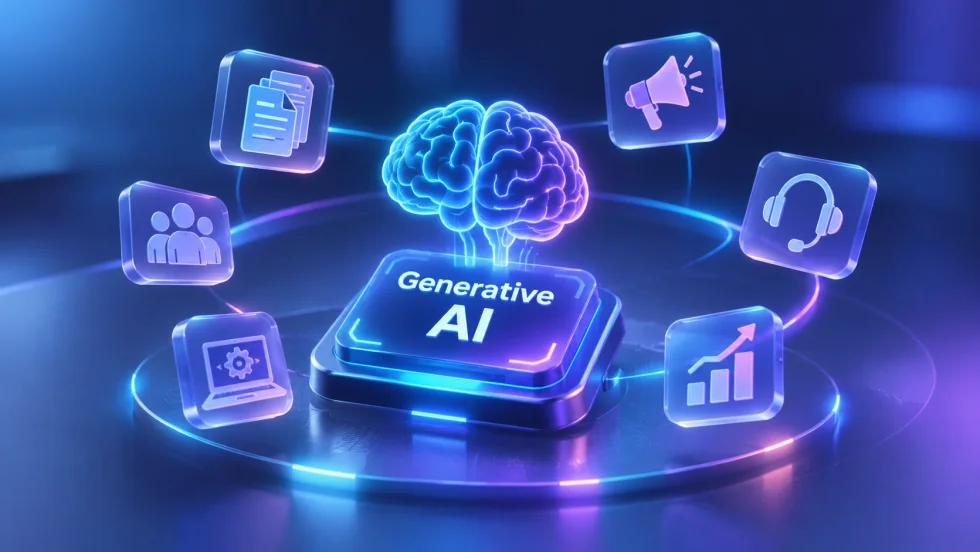
What if your business could automate repetitive tasks, analyze complex information, and generate reports without adding to employee workloads?
Generative AI is making these possibilities realistic. While many businesses associate artificial intelligence with chatbots and virtual assistants, its potential extends far beyond automated conversations.
Today, generative AI applications are helping organizations process documents, create content, analyze information, and streamline daily operations. From marketing and human resources to finance and customer service, teams are exploring how generative AI can reduce manual effort, improve productivity, and support better decision-making.
As organizations continue adopting digital technologies, generative AI development is becoming an important part of modern business transformation.
What Is Generative AI in Business Workflows?
Generative AI refers to artificial intelligence systems capable of creating new content, summarizing information, generating code, and producing useful outputs based on instructions and existing data.
Unlike traditional automation systems that follow predefined rules, generative AI can work with unstructured information such as emails, documents, customer feedback, and business reports.
For example, a traditional automation tool may transfer customer information from one system to another. A generative AI application can interpret the customer’s request, summarize relevant details, draft a response, and suggest the next action.
Successful implementation still requires appropriate data access, validation, human oversight, and security controls.
1. Automating Business Documents and Reports
Document processing is one of the most practical generative AI applications for businesses. Organizations regularly handle contracts, invoices, proposals, project reports, and internal documentation, and preparing or reviewing them manually can consume considerable time.
Generative AI can simplify these workflows by extracting relevant information, summarizing lengthy files, and generating structured drafts.
Common business applications
- Summarizing lengthy business reports and contracts
- Extracting important details from invoices and purchase orders
- Creating meeting summaries and action items
- Drafting business proposals and project documentation
- Comparing document versions and identifying changes
For example, a project management team can use generative AI to convert meeting notes into a structured summary containing responsibilities, deadlines, and follow-up actions. Employees spend less time organizing information and more time completing important tasks.
2. Improving Marketing and Content Creation Workflows
Marketing teams manage content development, campaign planning, email marketing, and social media at the same time. Generative AI for business can help by assisting with ideation, drafting, personalization, and campaign analysis.
How generative AI supports marketing
- Content generation: Blog outlines, website content, product descriptions, and social media drafts.
- Email marketing: Personalized email variations based on customer segments and campaign objectives.
- Campaign planning: Campaign concepts, messaging variations, and promotional ideas.
- Content optimization: Suggestions to improve readability, structure, and keyword relevance.
- Marketing analysis: Summaries of campaign results that highlight patterns worth investigating.
For example, an e-commerce business launching a new product can prepare product descriptions, promotional emails, and social posts from a single approved product brief. The marketing team then reviews and refines the material before publication, keeping human control over brand messaging.
3. Streamlining Human Resources and Employee Onboarding
Human resources teams handle recruitment, onboarding, employee communication, and policy management, much of which involves repetitive documentation. Generative AI applications can help HR teams organize information and deliver more consistent employee support.
Practical HR applications
- Drafting job descriptions and recruitment communications
- Preparing onboarding documents and employee guides
- Summarizing internal policies and procedures
- Generating employee training materials
- Answering routine questions using approved company knowledge
- Creating performance review templates
For example, when a new employee joins, a generative AI-powered onboarding system can prepare a personalized checklist based on the employee’s department, role, and responsibilities, and point them to the relevant policies and training resources.
Sensitive employment decisions should remain subject to human review, and employee information must be handled securely.
4. Enhancing Customer Service Beyond Traditional Chatbots
Chatbots are among the most familiar applications of AI, but generative AI can support a much broader range of customer service operations. Instead of only answering questions, it can assist support teams throughout the entire service process.
Advanced customer service applications
- Ticket summarization: Convert lengthy customer conversations into concise issue summaries.
- Response drafting: Generate context-aware replies using approved company knowledge.
- Knowledge management: Organize support documentation and suggest relevant troubleshooting steps.
- Feedback analysis: Identify recurring complaints, product issues, and improvement opportunities.
- Workflow assistance: Recommend next steps or route complex cases to the right department.
For example, when a customer submits a technical request, a generative AI application can analyze the issue, retrieve relevant troubleshooting documentation, and prepare a suggested response for the support representative. This reduces administrative effort and helps teams deliver more consistent service.
For a closer look at how AI agents handle support tasks end to end, read Beyond Chatbots: How AI Agents Are Changing Customer Support Workflows.
5. Simplifying Financial and Administrative Workflows
Finance and administrative teams work with structured records, supporting documents, financial summaries, and approval processes. Generative AI can help employees interpret information and prepare reports more efficiently.
Generative AI use cases in finance
- Summarizing financial reports
- Extracting details from invoices and receipts
- Preparing budget commentary
- Identifying unusual patterns for further investigation
- Drafting payment reminders and financial communications
- Explaining financial trends in natural language
For instance, a finance manager can use an AI-powered reporting assistant to summarize monthly expenses and flag categories showing significant changes. The finance team then verifies the explanation against the underlying records.
Generative AI should support financial professionals rather than replace accounting controls, reconciliation procedures, or approval requirements.
Quick definition: Human-in-the-loop. A workflow design in which AI prepares a draft, summary, or recommendation, and a person reviews and approves it before it is used or sent. It is the safeguard behind most of the applications in this post.
6. Supporting Sales Teams and Customer Relationship Management
Sales professionals spend considerable time preparing outreach messages, updating customer relationship management (CRM) systems, and reviewing prospect information. Generative AI applications can reduce these administrative tasks and improve access to customer insights.
How generative AI improves sales workflows
- Drafting personalized sales emails and follow-up communications
- Summarizing customer meetings and requirements
- Generating sales proposals
- Organizing CRM notes
- Preparing sales performance reports
For example, after a sales meeting, a generative AI application can turn approved notes into a summary of customer requirements, discussed solutions, and recommended next steps. With suitable CRM integration, it can also prepare updates for review before they are saved. Sales representatives can then focus more on customer relationships and business development.
7. Making Business Data Easier to Understand
Businesses generate large volumes of data through websites, customer interactions, sales platforms, and internal applications. Business intelligence tools help visualize it, but interpreting reports can still require specialized knowledge.
Generative AI can make data more accessible by enabling natural-language interaction with approved datasets.
Examples of AI-powered data analysis
- Generating summaries of monthly performance
- Explaining changes in sales or customer activity
- Identifying potential operational trends
- Creating narrative explanations for dashboards
- Preparing management reports
- Suggesting questions for further analysis
For example, a business manager might ask, “Which product categories experienced the largest sales decline this quarter?” An appropriately integrated AI system can query the authorized data, summarize the results, and present the findings in an understandable format.
Organizations should still validate AI-generated interpretations and enforce data access permissions.
8. Accelerating Software Development and IT Operations
Generative AI development is also changing how businesses build, maintain, and improve software. Development teams can use AI-assisted tools for coding, documentation, testing, and troubleshooting.
Generative AI applications in IT
- Generating initial code snippets
- Creating technical documentation
- Suggesting unit test cases
- Explaining existing code and assisting with debugging
- Summarizing technical incidents
- Drafting internal knowledge base articles
For example, a team maintaining a large application can use generative AI to explain unfamiliar code modules and suggest potential improvements. AI-assisted development can speed up routine activities, but generated code must still go through security reviews, functional testing, and quality assurance.
9. Transforming Internal Knowledge Management
Many organizations store valuable information across shared drives, internal portals, documentation systems, and collaboration platforms. Finding the right information becomes harder as businesses grow.
Enterprise generative AI solutions can improve knowledge discovery by connecting AI-powered assistants to approved organizational information. Employees ask questions in natural language and receive answers grounded in relevant internal documents.
Business benefits
- Faster access to company policies and procedures
- Less time spent searching documentation
- Easier onboarding for new employees
- Improved knowledge sharing between departments
- Better access to technical and operational guidance
For example, an employee preparing a client proposal can use an internal AI knowledge assistant to locate service information, approved project references, and proposal templates. When configured with source citations and access controls, these applications help employees retrieve information efficiently while respecting document permissions.
10. Integrating Generative AI With Existing Business Systems
One of the most important opportunities lies in connecting generative AI to systems employees already use, such as CRM platforms, ERP systems, document repositories, project management applications, and customer support software, instead of introducing isolated tools.
Example: an AI-powered business workflow
- Request received: An incoming email, support ticket, or business inquiry arrives.
- Generative AI analysis: The system understands intent, summarizes requirements, and retrieves approved knowledge.
- Draft output and human review: It prepares a response, suggested actions, and supporting details for a person to review.
- Business system integration: Authorized systems are updated and approved next steps are initiated.
This type of workflow combines generative AI with traditional automation, allowing businesses to process information and coordinate activities more efficiently.
To see where integrated business software is heading, read about AI-native enterprise applications.
Key Benefits of Generative AI Applications for Businesses
Organizations implementing generative AI may see several operational benefits:
| Business Benefit | Potential Impact |
| Improved productivity | Can reduce time spent on repetitive drafting and information processing |
| Faster information access | Helps employees retrieve relevant business knowledge |
| Better customer support | Assists with ticket analysis and response preparation |
| Content efficiency | Speeds up creation of first drafts and campaign materials |
| Improved collaboration | Makes documentation and knowledge sharing easier |
| Scalable operations | Supports growing workloads with less added manual effort |
Actual results depend on implementation quality, workflow suitability, data availability, and employee adoption.
Challenges to Consider Before Adopting Generative AI
Generative AI offers valuable opportunities, but organizations should address several challenges before deploying it across operations.
- Data privacy and security: AI systems should protect confidential business and customer data through appropriate security measures.
- Output accuracy: Generated content may contain incorrect or misleading information, so important outputs require verification.
- Integration complexity: Connecting generative AI to existing applications may require custom development and configuration.
- Employee adoption: Teams need training to use AI-powered applications effectively.
- Governance and compliance: Establish policies covering AI usage, accountability, data retention, and human oversight.
- Cost management: Evaluate infrastructure, model usage, maintenance, and operational expenses.
A carefully planned implementation helps manage these risks while delivering practical business value.
How to Get Started With Generative AI Development
Businesses do not need to automate every department at once. A phased approach helps identify valuable applications while controlling risk.
- Identify repetitive workflows: Review activities involving document preparation, information retrieval, reporting, and communication.
- Evaluate business value: Prioritize use cases by time savings, complexity, accuracy requirements, and expected return on investment.
- Assess data readiness: Make sure relevant business information is accurate, accessible, and protected.
- Develop a pilot application: Begin with a focused use case that has measurable objectives.
- Integrate existing systems: Connect the application to authorized business platforms where necessary.
- Measure and optimize: Monitor output quality, employee adoption, processing time, costs, and performance.
Successful applications can then be expanded into additional workflows.
Not sure where to begin? Our guide on how to identify business processes that are ready for AI automation can help you shortlist your first use case.
The Future of Generative AI in Everyday Business Operations
The next stage of adoption is likely to focus on integrated business applications rather than standalone conversational tools. Developments in multimodal AI, retrieval-augmented generation (RAG), and AI agents are creating opportunities for systems that interpret requests, retrieve information, coordinate multiple workflow steps, and assist employees with complex tasks.
For example, future workflows may combine document analysis, data retrieval, report preparation, and approval management in a single integrated process. Even so, businesses will need reliable governance, transparent processes, and human supervision to ensure dependable outcomes.
Companies that focus on practical use cases and measurable results will be better positioned to benefit from these technologies.
Building Practical Generative AI Solutions With eGrove Systems
Generative AI delivers the most value when it is designed around how a business actually operates. eGrove Systems helps organizations identify suitable workflows, connect AI to existing data and platforms, and build solutions that are secure and ready to grow. Our AI and machine learning services cover use-case discovery, generative AI, and integration with existing systems, while our AI chatbot development work supports conversational experiences for customers and teams. Beyond AI, our wider software solutions help businesses build the web, mobile, and enterprise applications these workflows depend on.
Conclusion
Generative AI is moving beyond chatbots and becoming a valuable part of everyday business operations. From document processing and content creation to customer service, financial reporting, and knowledge management, generative AI applications can help organizations streamline workflows and improve productivity.
The greatest value comes from applying AI to specific business challenges rather than adopting technology without a clear objective. By combining thoughtful workflow design, secure integrations, and human oversight, businesses can build intelligent applications that support long-term operational improvement.
With its experience across AI, software development, and digital transformation, eGrove Systems helps organizations start with practical, well-defined use cases and build a stronger foundation for future innovation.
Transform Everyday Business Workflows With Generative AI
Looking to reduce repetitive tasks, improve operational efficiency, and introduce intelligent automation into your business?
Contact eGrove Systems to discuss your generative AI development requirements.