
Online shopping has become an essential part of everyday life. However, many eCommerce websites still contain accessibility barriers that prevent people with disabilities from browsing products, accessing information, and completing purchases independently.
Artificial intelligence is changing how businesses identify and address these challenges. AI-powered accessibility testing enables online stores to detect accessibility issues, recommend improvements, and streamline website optimization. While AI offers significant opportunities, understanding its limitations is equally important for creating a genuinely inclusive shopping experience.
What Is AI-Powered Accessibility Testing?
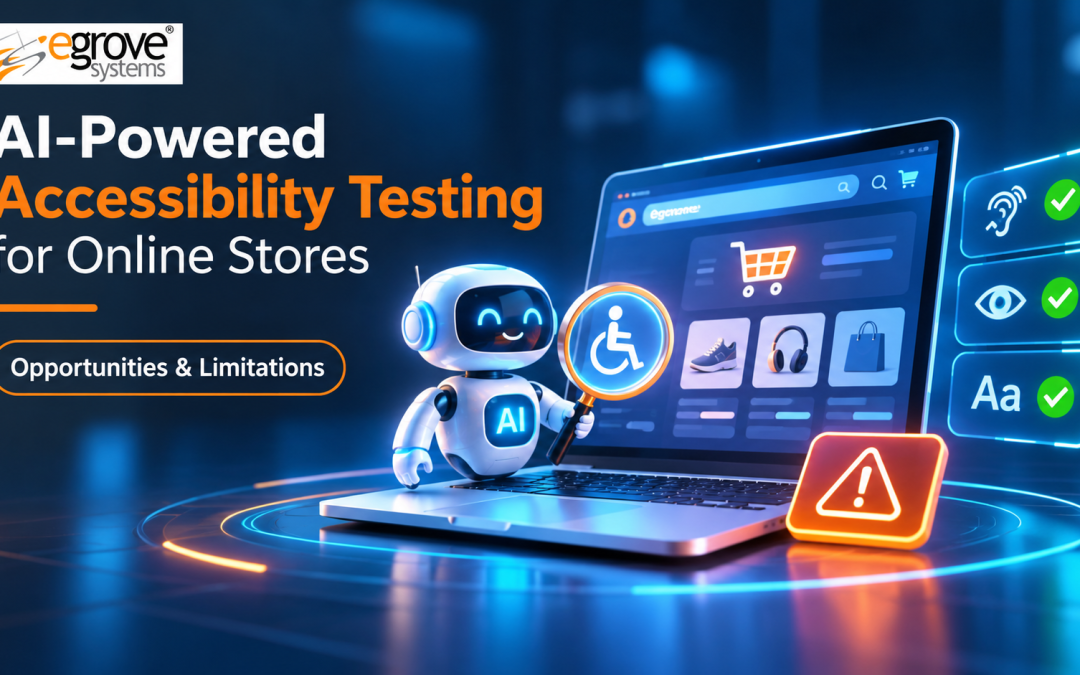
AI-powered accessibility testing uses artificial intelligence, machine learning, computer vision, and automated analysis to identify potential accessibility barriers across websites and applications.
Unlike conventional accessibility testing tools that primarily rely on predefined rules, AI-powered solutions can assist in analyzing website content, visual elements, navigation structures, and contextual information.
For eCommerce businesses, accessibility testing can help evaluate:
- Product images and alternative text
- Website navigation and menu structures
- Color contrast and text readability
- Product search and filtering options
- Shopping cart and checkout accessibility
- Form labels and error messages
- Heading structures and HTML elements
- Keyboard navigation and screen reader compatibility
These capabilities help businesses identify potential issues against accessibility standards such as the Web Content Accessibility Guidelines (WCAG).
Why Accessibility Matters for Online Stores
An accessible online store allows customers with different abilities to explore products, compare prices, and complete transactions with fewer barriers.
Poor website accessibility can result in abandoned shopping carts, lost sales, negative customer experiences, and potential legal risks.
By prioritizing digital accessibility, eCommerce businesses can improve customer satisfaction, reach a wider audience, strengthen brand reputation, and support applicable accessibility compliance requirements.
Opportunities of AI-Powered Accessibility Testing
1. Automated Accessibility Issue Detection
AI-powered accessibility testing tools can scan multiple website pages and identify common accessibility issues more efficiently than manual inspection alone.
These tools can detect missing alternative text, insufficient color contrast, unlabeled form fields, improper heading structures, and other accessibility barriers.
For online stores with thousands of product pages, automated testing can help reduce the initial auditing workload.
2. AI-Generated Alternative Text for Product Images
Product images play an important role in online shopping. Customers who use screen readers depend on meaningful alternative text to understand product characteristics.
AI-powered tools can analyze product images and generate descriptive alternative text based on visible features.
For example, instead of displaying generic alternative text such as “Product Image 01,” AI could suggest:
“Black leather handbag with gold-tone hardware and an adjustable shoulder strap.”
However, businesses should review AI-generated descriptions to ensure accuracy and relevance.
3. Faster Accessibility Issue Resolution
Modern AI accessibility solutions can go beyond identifying problems by recommending potential fixes.
AI-assisted remediation can help developers address missing image descriptions, incorrect HTML attributes, inaccessible form labels, and structural issues.
With appropriate review and approval workflows, businesses can reduce development effort and resolve recurring accessibility problems more efficiently.
4. Continuous Accessibility Monitoring
Online stores frequently update product listings, promotional banners, landing pages, and checkout functionality.
These changes can introduce new accessibility issues even after a website has undergone an accessibility audit.
AI-powered accessibility monitoring helps businesses regularly evaluate their websites, identify newly introduced barriers, and prioritize corrective actions.
Continuous monitoring is particularly valuable during seasonal sales, product launches, and major website updates.
5. Improved Shopping Experience
Accessibility improvements often benefit all customers, not just individuals with disabilities.
Clear navigation, readable content, descriptive buttons, properly structured forms, and understandable error messages can make online shopping easier for everyone.
AI-powered accessibility testing can support these improvements by identifying usability-related accessibility barriers throughout the customer journey.
6. Scalable Testing for Large eCommerce Websites
Large online stores may contain thousands of product pages, category pages, and dynamically generated content.
Manually reviewing every page can be time-consuming and expensive.
AI-powered accessibility testing allows businesses to evaluate large volumes of content, identify recurring problems, and prioritize issues based on their potential impact.
7. Supporting Accessibility Compliance
AI-powered accessibility testing can support businesses in identifying issues associated with:
- Web Content Accessibility Guidelines (WCAG 2.1 and 2.2)
- Americans with Disabilities Act (ADA)
- Section 508 accessibility requirements, where applicable
- European Accessibility Act (EAA), where applicable
Although automated testing cannot guarantee legal compliance, it can provide valuable insights for accessibility assessments and remediation planning.
Quick definition: WCAG
The Web Content Accessibility Guidelines (WCAG) are the W3C’s technical standard for making web content accessible to people with disabilities. They are organized around four principles: content must be perceivable, operable, understandable, and robust. WCAG 2.2 is a W3C Recommendation; read the official specification.
Limitations of AI-Powered Accessibility Testing
Despite its advantages, artificial intelligence cannot independently address every accessibility challenge.
1. Limited Understanding of Context
AI can identify whether an image has alternative text, but it may not always determine whether that description communicates the image’s intended purpose.
For example, an AI-generated description might identify a pair of shoes without mentioning important product characteristics that customers need to make purchasing decisions.
Human review remains essential to ensure contextual accuracy.
2. Incomplete Accessibility Coverage
Automated accessibility testing cannot reliably evaluate every WCAG success criterion.
Certain accessibility requirements involve human judgment, including logical reading order, meaningful link descriptions, understandable instructions, and the overall usability of complex interactions.
Businesses should not assume that passing an automated accessibility scan means their website is fully accessible.
3. Challenges with Dynamic eCommerce Features
Modern online stores use interactive elements such as product carousels, pop-up windows, live chat, personalized recommendations, and dynamic checkout forms.
AI-powered testing may struggle to evaluate every possible interaction, particularly when website content changes based on customer behavior.
Manual functional testing is necessary to ensure these features work effectively with assistive technologies.
4. False Positives and Undetected Issues
AI-powered accessibility tools may occasionally flag elements that are already accessible or overlook genuine accessibility barriers.
Relying entirely on automated recommendations can lead to unnecessary changes or unresolved problems.
Accessibility specialists and developers should validate findings before implementing fixes.
5. Limited Understanding of Real User Experiences
AI cannot fully replicate the experiences of individuals with visual, hearing, motor, or cognitive disabilities.
Real-world accessibility testing with people who use assistive technologies provides valuable insights that automated systems may miss.
Screen reader testing, keyboard-only navigation, and usability testing remain essential components of an effective accessibility strategy.
6. Risks of Automated Remediation
Automatically applying AI-generated fixes without proper validation can introduce new accessibility issues, affect website functionality, or alter the intended meaning of content.
Businesses should establish human approval, code validation, and regression testing processes before deploying AI-generated accessibility fixes.
AI-Powered Accessibility Testing vs. Manual Testing
| Testing capability | AI-powered testing | Manual testing |
| Large-scale website scanning | Highly efficient | Time-consuming |
| Missing alternative text detection | Effective | Effective |
| Alternative text quality evaluation | Limited | Contextually accurate |
| Color contrast detection | Effective for many cases | Detailed validation |
| Keyboard navigation testing | Partial coverage | Comprehensive evaluation |
| Screen reader experience | Limited | Detailed evaluation |
| Dynamic checkout testing | Partial coverage | Detailed functional testing |
| Continuous monitoring | Highly efficient | Resource-intensive |
| Compliance validation | Supporting evidence | Essential for comprehensive assessment |
Combining both approaches provides a more reliable accessibility testing strategy.
Best Practices for Implementing AI-Powered Accessibility Testing
Online stores can maximize the benefits of artificial intelligence by following a structured accessibility strategy.
- Conduct an initial accessibility audit: Scan product pages, category pages, landing pages, and checkout flows to identify existing barriers.
- Prioritize critical accessibility issues: Focus on problems that prevent customers from browsing products or completing purchases.
- Use AI-assisted remediation: Generate recommended fixes and review them before implementation.
- Perform manual accessibility testing: Evaluate keyboard navigation, screen reader compatibility, and interactive elements.
- Test with real users: Include people with disabilities in usability testing whenever possible.
- Monitor accessibility continuously: Schedule regular scans to detect issues introduced by website updates.
- Train development and content teams: Encourage accessible design, coding, and content creation practices.
- Maintain accessibility documentation: Record identified issues, remediation activities, and testing results.
The Future of AI in eCommerce Accessibility
Artificial intelligence is expected to play an increasingly important role in digital accessibility. Emerging capabilities include context-aware image descriptions, intelligent code remediation, automated user journey analysis, and proactive accessibility monitoring.
As these technologies evolve, businesses may be able to identify and resolve accessibility barriers earlier in the website development lifecycle.
However, the future of accessibility is not entirely automated. The most effective approach combines artificial intelligence, accessibility expertise, inclusive design principles, and real user feedback.
How Elite Site Optimizer Supports Website Accessibility
Elite Site Optimizer can serve as a supporting tool within a broader accessibility strategy, helping businesses identify website accessibility issues and streamline their optimization processes.
With accessibility auditing and AI-assisted optimization capabilities, eCommerce businesses can identify potential barriers, prioritize improvements, and support more accessible digital experiences.
AI-assisted remediation, combined with human review and approval, can help reduce repetitive manual work while maintaining control over website changes. By integrating accessibility testing into regular website maintenance, online stores can work toward a more inclusive shopping experience.
Conclusion
AI-powered accessibility testing offers significant opportunities for online stores to improve digital inclusivity, accelerate issue detection, reduce repetitive manual work, and support accessibility compliance efforts.
However, AI alone cannot guarantee a fully accessible website. Human expertise, manual testing, and real-world user feedback remain essential for addressing complex accessibility challenges.
By combining intelligent automation with responsible human oversight, eCommerce businesses can create more accessible, user-friendly, and inclusive shopping experiences.
At eGrove Systems, we help businesses build and optimize their digital experiences, and accessibility is an important part of that work. Whether you’re planning a new online store or improving an existing one, our team can help you create shopping experiences that work for more customers.
Ready to make your online store more accessible? Connect with the eGrove Systems team to discuss your goals.