
For companies weighing whether to start, expand, or relocate in the New York metro area, the state line matters more than it might seem. New Jersey and New York run two of the most active state economic development programs in the country, but they’re structured differently, target different company profiles, and reward different kinds of growth. Picking the wrong one, or missing the better fit entirely, can mean leaving real money on the table.
This breaks down how New Jersey’s NJEDA and New York’s Empire State Development (ESD) programs actually compare, so you can figure out which state’s incentives line up with what your business is trying to do.
” NJEDA vs. New York Development Programs
NJEDA offers accessible loans, grants, tax credits, and redevelopment support for New Jersey businesses. New York’s ESD programs emphasize job creation, capital investment, research, and targeted industries. The best option depends on your company’s location, size, industry, hiring goals, and investment plans. “
How the Two Agencies Are Structured
The New Jersey Economic Development Authority (NJEDA) is the state’s primary vehicle for business incentives, loans, tax credits, and real estate development support. It runs a wide portfolio of programs covering everything from small business lending to large-scale job creation tax credits.
Empire State Development (ESD) plays the equivalent role in New York, administering the state’s tax credit programs, discretionary grants, and regional development initiatives, including the Excelsior Jobs Program, New York’s flagship incentive tool.
Both agencies are discretionary in nature. Qualifying for a program doesn’t guarantee an award. Applications go through review, and in many cases the agency has to determine the incentive is a “material factor” in the business’s decision to invest, hire, or stay in the state.
Job Creation and Tax Credit Programs
This is where the two states diverge most clearly.
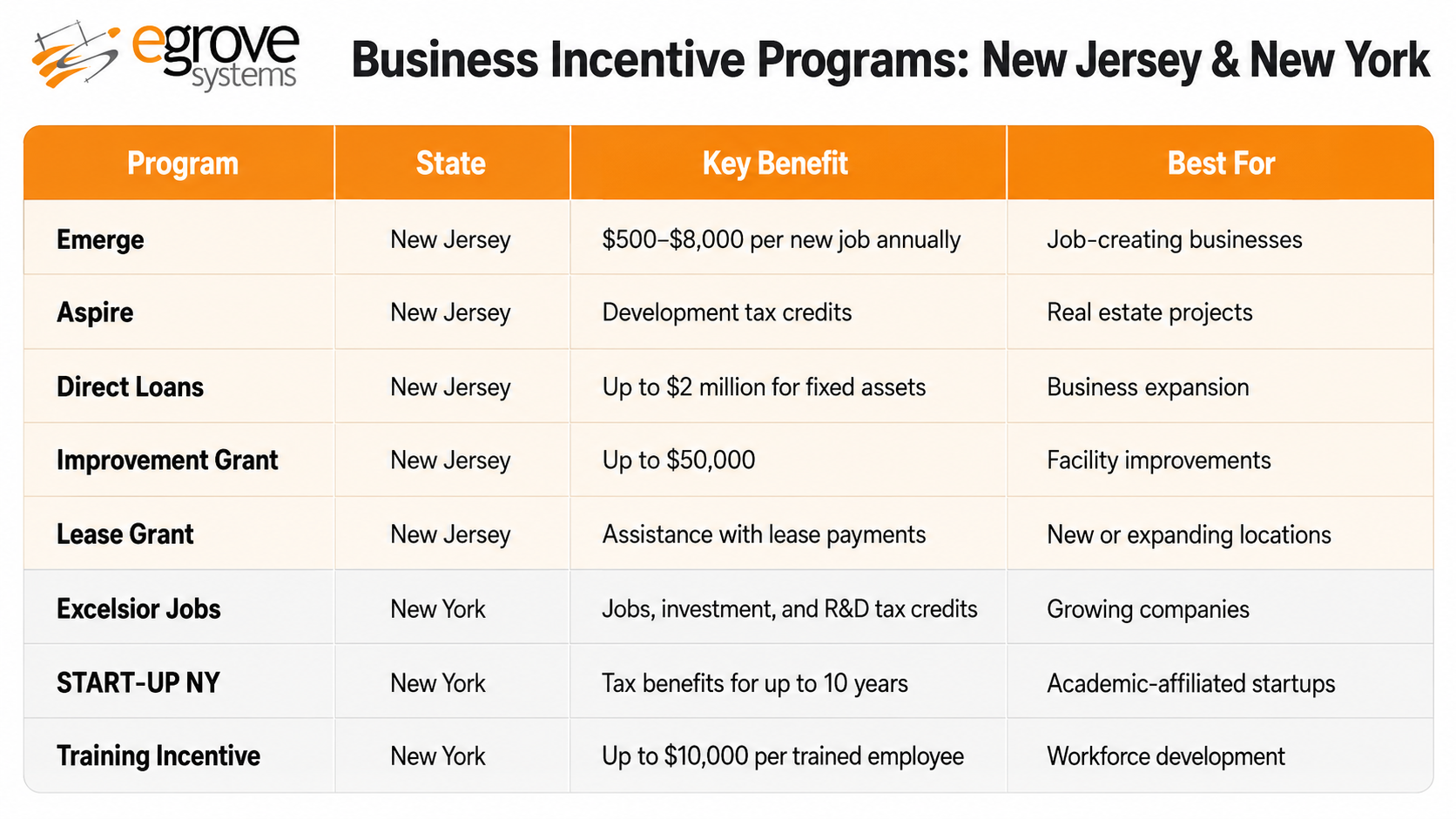
New Jersey’s Emerge Program provides per-job tax credits to projects that invest private capital and create a minimum of 35 full-time jobs, with credits ranging from roughly $500 to $8,000 per job, per year, depending on project location, bonus criteria, and net benefit to the state. Credits can offset tax liability directly or be sold for 85 to 90 percent of their value, which matters for early-stage companies that don’t yet have New Jersey tax liability to offset.
New York’s Excelsior Jobs Program works differently. Rather than a single flat credit, it bundles up to five separate refundable tax credits, including a jobs tax credit worth up to 6.85 percent of wages per net new job (7.5 percent for green or Green CHIPS projects), an investment tax credit, and a dedicated R&D credit worth 50 percent of a company’s federal R&D credit, capped at 6 percent of in-state research spending. Businesses claim these credits over a benefit period of up to 10 years, and eligibility is industry-specific, covering targeted sectors like biotech, clean tech, financial services, and manufacturing.
The practical difference: Emerge is a simpler, single-credit structure tied directly to job count and location. Excelsior is a more layered program that rewards a broader mix of activity, jobs, capital investment, and R&D spend, but requires meeting sector-specific thresholds to qualify in the first place.
Real Estate and Large-Scale Development
For real estate and mixed-use development, New Jersey’s Aspire Program is a gap-financing tool aimed at commercial, mixed-use, and residential projects that wouldn’t otherwise be economically feasible without state support. Award caps run from $50 million to $350 million, or 30 to 50 percent of project costs, depending on location and use.
New York doesn’t have a direct one-to-one equivalent, but ESD’s Business Expansion & Retention Grants serve a similar discretionary function, providing grants sized to capital investment, job creation or retention, industry, and project wages. New York also layers in region-specific tools like the Regional Economic Development Councils (REDC), which route state capital grants and tax credits through locally driven regional strategies rather than a single statewide formula.
Small Business and Early-Stage Support
NJEDA has a deeper bench of small business-specific tools than ESD does. The Direct Loan Program offers up to $500,000 in working capital for small businesses and up to $2 million for fixed assets, at rates tied to the 5-Year Treasury. The Small Business Improvement Grant and Small Business Lease Grant support tenant fit-out and lease costs directly, and the Angel Investor Tax Credit gives investors in New Jersey emerging technology and life sciences companies a credit against their investment, which indirectly makes it easier for early-stage companies to raise capital in-state.
New York’s closest equivalent for early-stage tech companies is START-UP NY, which pairs new and expanding businesses with academic institutions and offers tax-based incentives tied to those partnerships, rather than a direct cash grant or loan. New York also runs the Employee Training Incentive Program, a refundable credit for employers that invest in skills training or advanced-technology internships, capped at $5 million annually statewide.
Specialized and Industry-Specific Programs
Both states have built out incentive tracks for high-priority sectors, though the emphasis differs.
New Jersey has leaned hard into targeted, headline-grabbing incentives recently, including the Next New Jersey Program – AI, which offers substantial tax credits for companies investing $100 million or more in capital expenditure and creating 100 or more high-paying AI jobs in the state. It also runs sector-specific tools like the Food Desert Relief Tax Credit, Brownfields Redevelopment Incentive Program, and Historic Property Reinvestment Program for adaptive reuse projects.
New York’s specialized tracks lean toward life sciences and clean energy: the Life Sciences Research and Development Tax Credit, the Empire State Jobs Retention Program (for businesses at risk of leaving due to natural disaster impact), and continued state investment in the Empire AI initiative through capital grants.
Which State Fits Which Business
There’s no universal answer, but a few patterns hold up:
Early-stage and small businesses generally find New Jersey’s toolkit more accessible. NJEDA’s direct loans, lease and improvement grants, and Angel Investor Tax Credit are built for companies that don’t yet have the job counts or capital investment scale that most New York programs require.
Companies making a large, defined capital commitment, particularly in AI, manufacturing, or life sciences, have strong options in both states, but the right fit depends on the specific dollar thresholds and job counts each program requires. New Jersey’s Next New Jersey and Emerge programs reward scale directly; New York’s Excelsior program rewards a broader mix of job creation, investment, and R&D activity stacked together.
R&D-intensive businesses, especially in life sciences, benefit from New York’s dedicated R&D credit structure inside Excelsior, which is more explicitly built around research spending than New Jersey’s comparable tools.
Real estate and redevelopment projects have a clearer, purpose-built path in New Jersey through Aspire and the Historic Property Reinvestment Program, where New York’s support tends to be more regionally distributed through REDC funding rather than a single dedicated large-project vehicle.
A Few Things to Verify Before Applying
Regardless of which state looks like the better fit on paper, a few things are worth confirming directly with the agency before building a business case around a specific program:
- Current award caps, credit percentages, and program funding levels, since several of these programs (particularly NJEDA’s newer AI and manufacturing tracks) are periodically updated or re-capped.
- Whether the program is currently open to new applications. Both agencies close and reopen specific programs, and some run through defined application windows or auction periods rather than accepting applications continuously.
- Compliance obligations attached to any award. Both states require ongoing certification, often including independent verification of job counts, wages, and capital investment, throughout the benefit period, and failing to meet those commitments can affect or claw back the credit.
Neither state’s program list is static, and the right comparison depends heavily on company size, industry, and the specific type of investment being made. Reviewing the current eligibility criteria directly with NJEDA or ESD, or with an advisor familiar with both states’ programs, is worth doing before committing to a location decision based on incentives alone.
A Note on Working With NJEDA Directly
For New Jersey small businesses specifically, it’s worth knowing that NJEDA’s programs are often delivered through a network of approved consulting partners rather than the agency handling every project in-house. eGrove Systems, based in East Brunswick, is one of NJEDA’s approved partner consultants for the Small Business E-Commerce Support Program, part of the state’s Main Street Recovery initiative, and has worked with more than 150 New Jersey small businesses on website development, e-commerce integration, and digital marketing at no cost to the business. It’s a useful example of how these state programs actually reach businesses on the ground: through vetted local partners who handle execution once a business is approved.
If your business qualifies for NJEDA’s E-Commerce Support Program, reach out to eGrove Systems to check eligibility and get started.