

Mobile apps have become a core part of almost every business strategy, whether you’re launching an eCommerce storefront, a customer service tool, a healthcare solution, or an internal enterprise app. The approach you choose to build it directly shapes your budget, your time to market, how well it scales, and the experience your customers actually get.
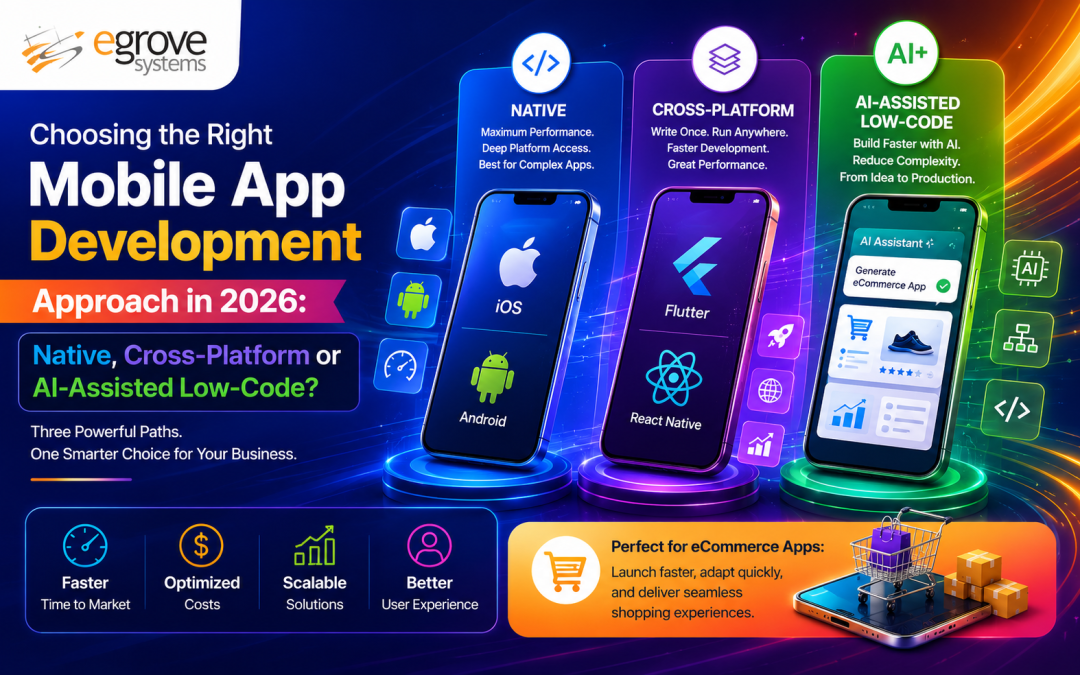
In 2026, that choice comes down to three primary paths: native development, cross-platform development, and AI assisted low code development. Each has matured considerably over the past few years, cross platform tools have closed most of the performance gap with native AI coding assistants now embedded directly into build pipelines, and low-code platforms have moved from “quick prototype” territory into genuine production use. That’s good news for founders and product teams, but it also means the decision needs a bit more nuance than it used to.
This guide breaks down what each approach means in 2026, where it wins, where it falls short, and how to match it to your project, with a closer look at what AI-assisted low-code looks like in practice for eCommerce apps.
Cross platform development means creating one application that works on multiple operating systems mainly iOS and Android using a shared codebase. Frameworks such as Flutter, React Native, and .NET MAUI help developers build and maintain both versions simultaneously.
Benefits include:
- Faster development
- Lower development costs
- Consistent design across platforms
- Easier updates and maintenance
1. Native App Development: Still the Performance Benchmark
Native development means building separately for each platform, Swift (or Objective-C) for iOS and Kotlin (or Java) for Android, using each platform’s own tools and APIs.
Best for: banking and finance, healthcare, enterprise applications, gaming, and other high-performance or hardware-dependent apps.
Advantages:
- Exceptional, best-in-class performance
- Full access to device hardware and the newest OS features
- Maximum security and platform-level control
- Highly scalable for complex, long-term products
Considerations:
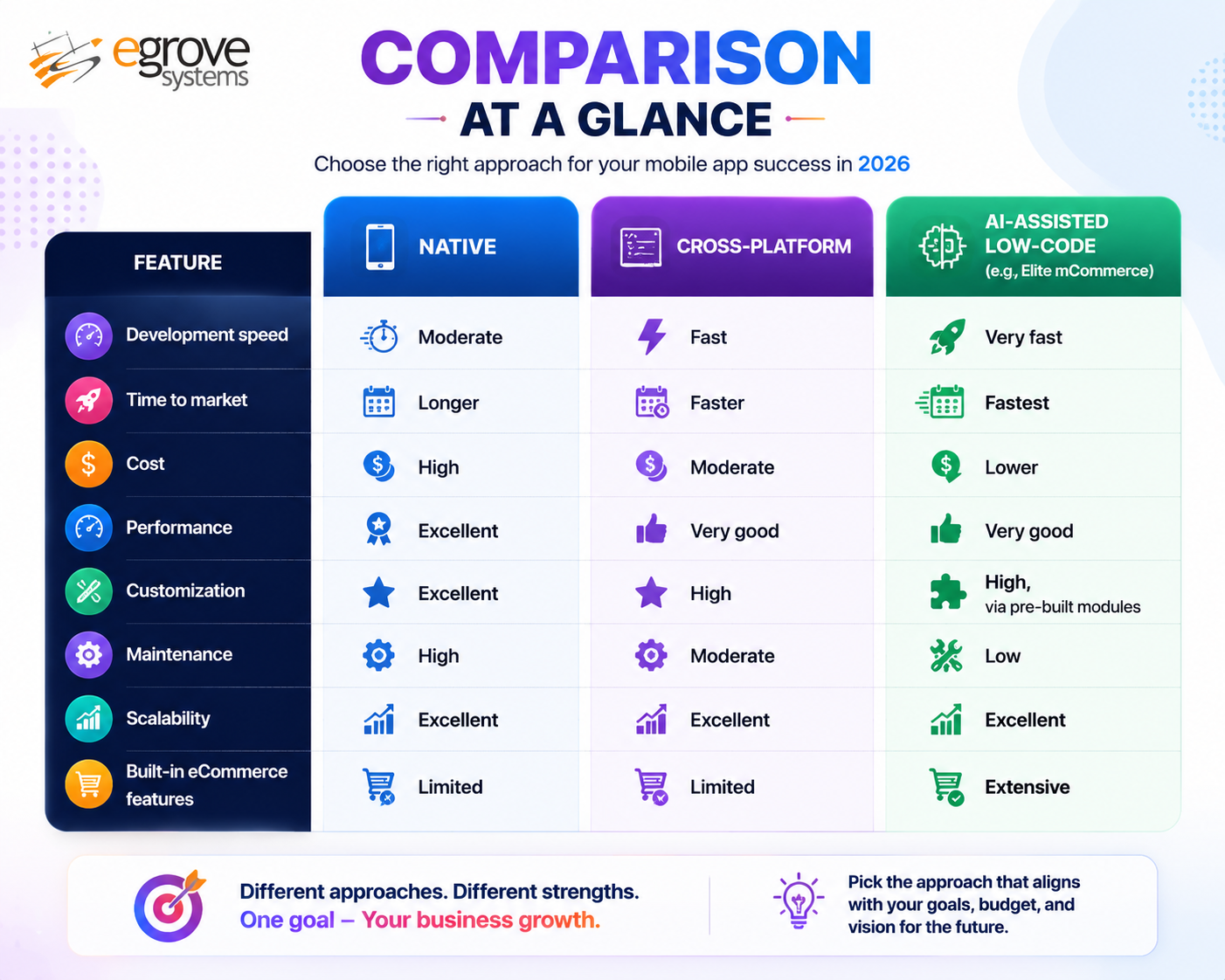
- Higher development cost, since you’re effectively funding two builds
- Longer development timeline
- Separate codebases for Android and iOS mean feature parity takes longer to maintain
Native remains the right call for apps where performance, security, or deep hardware access is the product itself, not just a feature of it.
2. Cross-Platform Development: The Default for Most New Projects
Cross-platform frameworks like Flutter, React Native, and Kotlin Multiplatform let you write one codebase and ship it to both iOS and Android. Performance has closed enough of the gap with native that this approach now handles the large majority of new mobile projects outside of gaming and specialized hardware use cases.
Best for: startups, retail and eCommerce, food delivery, booking apps, and general business applications.
Advantages:
- Faster development, since one codebase covers both platforms
- Reduced cost compared to maintaining two native builds
- Easier long-term maintenance
- Consistent user experience across devices
Considerations:
- Slightly lower performance ceiling than pure native, though negligible for most business apps
- Custom, platform-specific features may still need additional native modules
For most B2C and B2B apps, retail, on-demand services, internal tools, and content platforms, cross-platform is now the practical starting point rather than the exception.
3. AI-Assisted Low-Code Development: From Prototype Tool to Production Path
This is the category that’s changed the most. Low-code and no-code platforms used to be seen as a shortcut for MVPs and internal tools. In 2026, AI has pushed them further: platforms now generate scaffolding, automate large parts of testing, and offer AI-powered workflows that shrink build timelines from months down to weeks.
Best for: rapid MVPs, internal business apps, customer portals, workflow automation, and eCommerce solutions.
Advantages:
- Fastest time to market of the three approaches
- Lower development costs
- AI-assisted workflows that speed up build, testing, and updates
- Quick integration with existing systems and platforms
Considerations:
- Customization can hit limits for highly complex or unusual application logic
- Some business requirements may still need custom coding on top of the platform
- Vendor lock-in is worth weighing, since migrating off a low-code platform later can be harder than migrating between codebases you own outright
- AI-generated code still benefits from human review; industry research shows that while AI adoption and productivity gains are both high, it also correlates with more delivery instability if left unchecked
Why AI-Assisted Development Is a Strong Fit for eCommerce
For businesses planning to launch an online shopping app specifically, AI-assisted low-code platforms offer a faster, more cost-effective path to market without giving up the features a real commerce app needs. Instead of building every capability from scratch, businesses can launch on a foundation that already includes the pieces a shopping app is expected to have.
Opt for This: Elite mCommerce as a Purpose-Built Example
Elite mCommerce is a good illustration of what “opt for this” looks like in the eCommerce category: a low-code m-commerce app builder aimed at retail, grocery, restaurant, salon, laundry, meat delivery, and pet-grooming businesses, with app launches advertised within days rather than months, at a fraction of the cost of a conventional custom build.
Feature areas worth looking for in a platform like this include:
- Multi-store and multi-vendor marketplace support, so a business can manage more than one storefront or onboard vendors from a single platform.
- Live inventory synchronization across sales channels, keeping stock levels accurate in real time.
- Smart product search, category navigation, and discovery features like top-selling product highlights, a “Buy It Again” reorder option, and Google Voice Search.
- Secure checkout with multiple payment gateways, including e-wallets and flexible payment options.
- Loyalty rewards, customer wallets, coupons, and subscriptions to support retention, not just first-time conversion.
- Push notifications and personalized promotions, including custom, business-defined alerts.
- Delivery scheduling, curbside and store pickup, and order tracking, plus built-in delivery partner integrations (carriers like FedEx, USPS, DoorDash, and Uber Direct).
- Order and store operations support, such as editing an order without cancellation and POS integration (including Magento POS).
- Platform interoperability, with support for connecting to existing storefronts like Shopify, WordPress, and Magento.
- Multi-language and multi-currency support for reaching a broader, global customer base.
- Built-in AI chatbot, handling common customer queries, guiding purchases, and resolving issues in real time to reduce support workload.
- Analytics, customer engagement, and marketing tools, plus brand customization through unlimited themes, a customizable homepage, and reusable layouts.
These built-in capabilities meaningfully cut development time while still giving a business a scalable foundation to grow on, and it’s the kind of feature set worth opting for when the goal is a working, revenue-ready commerce app fast, with room to layer in more custom development later if the business outgrows the template.
Comparison at a Glance
Which Approach Should You Choose?
Choose native development if:
- You need maximum performance and security
- Your app depends on advanced device hardware or capabilities
- You have a larger budget and a longer development timeline
Choose cross-platform if:
- You need Android and iOS apps quickly
- You want to reduce development costs without sacrificing much performance
- You need a balance between speed and quality
Choose AI-assisted low-code (like Elite mCommerce) if:
- You want to launch your eCommerce app quickly
- You need enterprise-ready shopping features from day one
- You want built-in integrations, automation, and scalability without building them yourself
- You prefer a faster ROI with lower development effort
These paths also aren’t always mutually exclusive. Some teams validate with a low-code build, then migrate to a cross-platform or native rebuild once usage and requirements are clearer. Others start cross-platform and drop into native modules only for the specific features that need it.
Final Thoughts
At eGrove Systems, we recognize that choosing the right mobile app development approach depends entirely on your business objectives, budget, and technical requirements. Whether you need high-performance native app development for hardware intensive applications or cost-effective cross-platform solutions for fast delivery, our expert engineering team builds solutions tailored to your strategy.
For businesses looking to launch feature rich mobile storefronts, eGrove Systems delivers rapid scalability through our AI assisted low code platform, Elite mCommerce. With extensive built-in capabilities ranging from product and delivery management to secure payments, customer engagement, and advanced analytics eGrove Systems empowers you to accelerate time-to-market, minimize development overhead, and focus on scaling your business rather than building core infrastructure from scratch.