

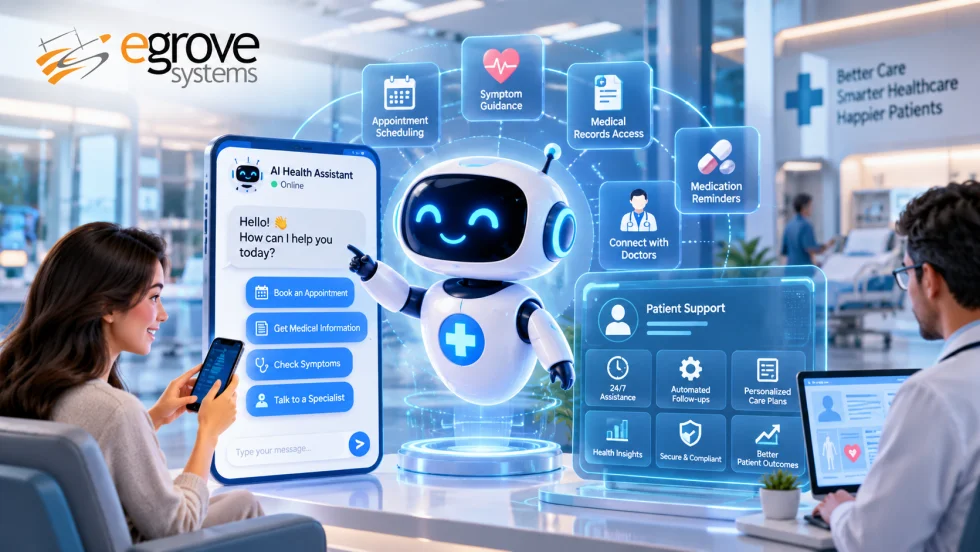
Healthcare organizations are constantly looking for better ways to support patients, manage daily operations, and improve communication. From scheduling appointments to answering common questions about medical services, patients expect convenient and timely assistance throughout their healthcare journey.
However, handling these requests manually can become challenging for hospitals, clinics, and healthcare service providers, especially when patient inquiries increase.
This is where AI chatbot development is making a meaningful difference.
AI-powered chatbots help healthcare organizations automate routine interactions, provide information around the clock, and connect patients with the right services. By combining artificial intelligence with healthcare workflows, these solutions can improve the patient experience while helping medical teams focus on responsibilities that require human attention.
What Is AI Chatbot Development in Healthcare?
AI chatbot development in healthcare involves building intelligent conversational applications that communicate with patients, answer common questions, and assist with administrative healthcare tasks.
Unlike traditional chatbots that rely mainly on predefined responses, AI-powered chatbots can use natural language processing (NLP) and machine learning to understand user inquiries and generate more relevant responses.
For example, a patient visiting a hospital website may ask:
- How can I schedule an appointment with a dermatologist?
- What are the hospital’s consultation hours?
- How do I prepare for my upcoming appointment?
- Where can I access my laboratory reports?
- Can I reschedule my appointment?
A properly integrated healthcare chatbot can guide patients through these requests without requiring hospital staff to respond manually to every inquiry.
More advanced chatbots can also connect with appointment management platforms, patient portals, and electronic health record systems, subject to appropriate authorization and privacy protections.
How AI Chatbots Are Transforming Healthcare Services
1. Providing 24/7 Patient Support
Patients may need healthcare information outside regular hospital working hours. Waiting until the next business day for basic assistance can create inconvenience and uncertainty.
AI healthcare chatbots provide continuous access to approved information about services, appointment availability, visiting hours, and administrative procedures.
For instance, someone searching for information about specialist consultations can interact with a chatbot late in the evening and receive guidance on available booking options.
This improves access to routine support while reducing the number of repetitive inquiries handled by reception teams.
2. Simplifying Appointment Scheduling and Management
Appointment scheduling is one of the most practical applications of AI chatbot development in healthcare.
Patients frequently contact hospitals to book consultations, check available time slots, or change existing appointments. Handling these activities manually requires considerable administrative effort.
An AI-powered chatbot integrated with a scheduling system can help patients:
- Check available appointments.
- Select preferred doctors or departments.
- Book, reschedule, or cancel consultations.
- Receive appointment confirmations.
- Get automated reminders before scheduled visits.
For example, a patient seeking a cardiology consultation can select a suitable date and time through a hospital chatbot without making multiple phone calls.
Such automation helps healthcare providers organize scheduling workflows and can reduce avoidable administrative delays.
3. Improving Patient Communication and Engagement
Clear communication plays an important role in creating a positive healthcare experience.
Patients often need information before appointments, during treatment, and after receiving medical services. When communication is delayed or difficult to access, patients may struggle to understand their next steps.
Healthcare chatbots can support communication by providing appointment instructions, sharing approved educational resources, and reminding patients about scheduled follow-up activities.
For instance, after a consultation, a chatbot may remind a patient about an upcoming follow-up appointment or direct them to clinician-approved recovery instructions.
These interactions help patients stay informed without replacing communication with qualified healthcare professionals.
Key Term: Retrieval-Augmented Generation (RAG)
RAG is a technique in which a chatbot retrieves information from approved, up-to-date sources, such as a hospital’s own service pages and policy documents, before generating a response. Grounding answers in verified content helps reduce the risk of incorrect or outdated information.
4. Reducing Administrative Workload for Healthcare Teams
Healthcare professionals and administrative employees manage numerous tasks throughout the day.
Alongside patient care, hospitals must handle appointment inquiries, registration information, service requests, and routine communications.
AI chatbot development can help automate suitable administrative activities such as:
- Responding to frequently asked questions.
- Collecting basic appointment requests.
- Directing patients to the appropriate department.
- Providing billing and insurance process information.
- Sharing hospital policies and service availability.
By automating repetitive interactions, healthcare organizations can give their staff more time to manage complex inquiries and support patients who need personal assistance.
5. Supporting Personalized Patient Experiences
Every patient has different healthcare needs, preferences, and communication requirements.
AI-powered healthcare chatbots can provide more relevant assistance based on information that patients choose to share and data they are authorized to access.
For example, a returning patient may receive appointment reminders for their chosen department, while a new patient may receive guidance on registration and consultation procedures.
Healthcare organizations can also design multilingual chatbot experiences to help patients communicate in their preferred language.
Personalization should always operate within clear privacy boundaries, with suitable patient consent, access controls, and human assistance when needed.
6. Helping Patients Navigate Healthcare Services
Finding the correct department or service can sometimes be confusing, particularly in large hospitals offering multiple specialties.
Healthcare chatbots can simplify this process by helping users locate relevant services and understand how to access them.
A chatbot may help someone find information about diagnostic testing, specialist departments, vaccination programs, or telehealth appointments.
Some healthcare systems also explore AI-assisted symptom information and triage. However, these applications require stronger clinical validation, safety testing, and regulatory evaluation.
AI chatbots should not independently diagnose medical conditions, prescribe treatment, or replace professional medical judgment. Patients reporting urgent or potentially serious symptoms should be directed to appropriate emergency services or qualified medical professionals.
Key Benefits of AI Chatbot Development for Healthcare Organizations
Implementing a well-designed healthcare chatbot can create operational and service improvements across different areas.
Improved patient accessibility: Patients can obtain routine information and administrative support without depending entirely on staff availability.
Faster response to common inquiries: Automated conversations can answer frequently asked questions without unnecessary waiting.
Greater administrative efficiency: Repetitive tasks can be handled through automated workflows, allowing employees to concentrate on more complex responsibilities.
Better appointment coordination: Integrated scheduling, confirmations, and reminders can simplify communication between patients and healthcare providers.
Scalable patient communication: Chatbots can manage multiple routine conversations simultaneously, helping organizations handle growing inquiry volumes.
Consistent information delivery: When connected to verified and regularly updated information sources, chatbots can provide more consistent answers about hospital services and procedures.
These benefits depend on proper implementation, reliable integrations, ongoing monitoring, and the suitability of each automated workflow.
Important Features of an AI Healthcare Chatbot
The effectiveness of a healthcare chatbot depends on how well its capabilities match patient requirements and organizational workflows. Healthcare organizations evaluating chatbot solutions should consider the following features.
Natural Language Processing
NLP allows a chatbot to interpret questions expressed in everyday language rather than requiring patients to follow rigid commands.
Appointment System Integration
Connecting a chatbot with scheduling software enables patients to check availability and manage consultations through conversational interactions.
Multilingual Communication
Supporting multiple languages can improve accessibility for patients from different linguistic backgrounds.
Secure Patient Data Handling
Healthcare chatbots should use appropriate encryption, authentication, access restrictions, data retention controls, and secure integrations to protect sensitive information.
Many healthcare chatbots depend on cloud infrastructure to process requests and connect with patient management systems. This makes secure data storage, access controls, and reliable cloud configurations especially important. Healthcare organizations can explore these HIPAA and cloud security best practices to better understand how to protect sensitive information when adopting cloud-based technologies.
Human Support Escalation
A chatbot should offer a clear way to connect patients with hospital staff or qualified healthcare professionals when a request is complex, sensitive, or outside its capabilities.
Analytics and Performance Monitoring
Healthcare teams can analyze chatbot performance using metrics such as response accuracy, task completion, patient satisfaction, and successful staff handoffs.
Accessibility-Friendly Design
Chatbot interfaces should support keyboard navigation, screen readers, understandable instructions, and accessible interaction patterns to accommodate users with different abilities.
Challenges to Consider When Developing Healthcare AI Chatbots
Although AI-powered chatbots offer valuable opportunities, healthcare organizations must address important challenges before deployment.
Patient data privacy: Healthcare information is sensitive. Organizations must evaluate applicable privacy and security requirements, including the HIPAA Privacy Rule in relevant US healthcare settings and other applicable regional regulations.
Protecting patient information should be a priority when introducing AI into healthcare services. Organizations need to consider how patient data is collected, stored, and accessed throughout chatbot interactions. Understanding the relationship between AI in healthcare and HIPAA regulations can help healthcare providers make more informed decisions about privacy, compliance, and responsible AI adoption.
Response accuracy: AI-generated answers may contain incorrect or incomplete information. Medical content requires approved sources, testing, and ongoing quality checks.
Integration complexity: Connecting chatbots with electronic health records, hospital management systems, and appointment software requires careful technical planning.
Patient trust: Healthcare organizations should clearly explain when patients are interacting with AI and how they can reach a human representative.
Regulatory considerations: Chatbots providing clinical decision support, diagnostic recommendations, or other medical functions may be subject to additional regulatory requirements depending on their intended use.
Addressing these concerns during development helps organizations build more reliable, transparent, and patient-focused chatbot solutions.
How to Implement AI Chatbot Development in Healthcare
Successful healthcare chatbot development begins with understanding where automation will create the most value.
Step 1: Identify healthcare service requirements. Determine whether the chatbot will support appointment scheduling, hospital inquiries, patient registration, billing assistance, or other approved workflows.
Step 2: Design patient-friendly conversations. Create clear and accessible conversational experiences that help patients complete tasks with minimal confusion.
Step 3: Select suitable AI technologies. Choose appropriate NLP capabilities, AI models, integration frameworks, and infrastructure based on the chatbot’s intended functions.
Step 4: Integrate healthcare systems securely. Connect the solution with authorized appointment, administrative, or patient information platforms using secure interfaces.
Step 5: Test accuracy, security, and usability. Evaluate the chatbot’s responses, privacy protections, accessibility, escalation procedures, and performance before release.
Step 6: Monitor and continuously improve. Review real-world interactions, update approved information, address response errors, and refine workflows as organizational needs evolve.
A phased implementation beginning with low-risk administrative tasks is often a practical way to introduce conversational AI into healthcare environments.
The Future of AI Chatbot Development in Healthcare
As artificial intelligence continues to advance, healthcare chatbots are expected to become more capable of handling complex conversational workflows and integrating with digital healthcare platforms, including mobile applications and patient portals.
Emerging possibilities include more natural voice-based interactions, multilingual patient communication, improved administrative coordination, and closer integration with remote healthcare services.
For example, AI chatbots may help patients navigate telehealth appointments, access approved educational information, or communicate routine service requirements across different digital channels.
Healthcare providers may also explore AI-enabled tools, including agentic AI systems, that help employees retrieve approved information and manage nonclinical tasks more efficiently.
As conversational AI develops, healthcare organizations may explore more advanced systems that can coordinate multiple administrative tasks. For example, an AI assistant could retrieve approved information, initiate scheduling workflows, and route requests to the appropriate staff. Understanding the benefits and applications of agentic AI provides useful context for how these capabilities may support future healthcare operations.
However, the future of AI in healthcare will depend not only on technical capabilities but also on patient safety, transparent operations, clinical oversight, privacy protection, and responsible governance.
The most effective solutions will combine intelligent automation with human expertise rather than attempting to replace healthcare professionals.
How eGrove Systems Supports Healthcare AI Chatbot Development
Building a healthcare chatbot takes more than a language model. It requires thoughtful conversation design, secure architecture, dependable integrations, and a clear understanding of how patients and care teams actually work.
eGrove Systems builds custom, secure, and scalable AI chatbots that connect with the systems organizations already rely on. From defining use cases and designing patient journeys to development, testing, and ongoing optimization, our teams focus on practical solutions that grow with your needs. Learn more about our AI chatbot development services.
Conclusion
AI chatbot development is changing how healthcare organizations communicate with patients and manage everyday service requirements.
From 24/7 patient assistance and appointment scheduling to automated administrative workflows and personalized communication, healthcare chatbots can help organizations deliver more convenient and accessible services.
At the same time, successful adoption requires careful attention to information accuracy, patient privacy, accessibility, regulatory requirements, and appropriate human oversight.
With deep experience in AI, digital engineering, and secure technology solutions, eGrove Systems helps healthcare organizations turn emerging technology into reliable, patient-centered digital experiences.
Ready to explore what AI can do for your healthcare organization? Connect with the eGrove Systems team today.