
Search doesn’t work the way it did even two years ago. A growing share of people never click through to a website at all; they ask ChatGPT, Google AI Overviews, Perplexity, or Gemini a question and act on whatever answer comes back. Being ranked on page one no longer guarantees visibility. Being the source an AI system chooses to cite does.
That shift is why “SEO” alone isn’t the full picture anymore. Three layers now determine whether your business shows up: traditional SEO (the technical and authority foundation everything else sits on), AEO (Answer Engine Optimization being extractable as a direct answer), and GEO (Generative Engine Optimization being the source AI systems cite and recommend). They aren’t competing strategies. They’re the same foundation, extended in different directions.
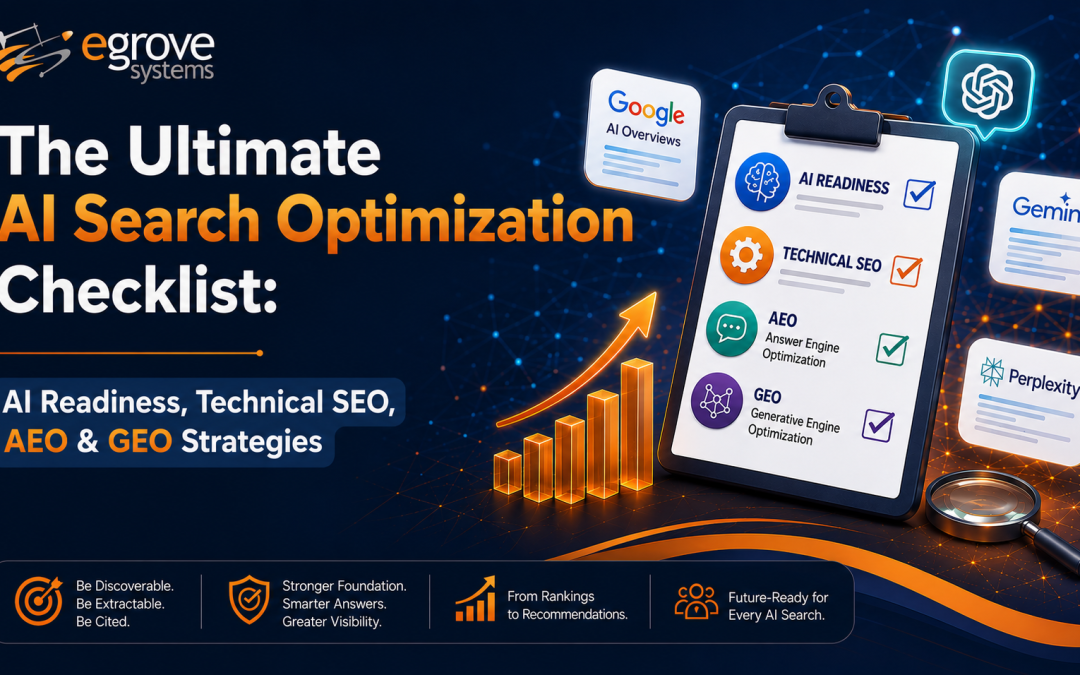
This checklist walks through all three, organized the way you’d actually work through an audit: readiness first, then technical foundation, then AEO, then GEO.
Part 1: AI Readiness Audit
Before optimizing anything, find out where your site actually stands with AI systems today.
- Check whether AI engines can already find you. Ask ChatGPT, Perplexity, and Google AI Overviews a question your business should be the answer to. Note whether you’re mentioned, cited, or absent entirely.
- Audit your robots.txt for AI crawlers. Confirm you aren’t accidentally blocking GPTBot, Google Extended, PerplexityBot, or ClaudeBot, a common and easily missed mistake.
- Confirm your content is server-rendered or pre-rendered, not dependent on client-side JavaScript that AI crawlers can’t reliably execute.
- Check crawl and indexation status in Google Search Bing Webmaster Tools to confirm AI-adjacent crawlers (which often share indexation signals with traditional search) can access your key pages. Elite Site Optimizer surfaces indexability issues as part of its standard site audit report.
- Identify your 5-10 highest-intent pages the ones you most want an AI system to cite and prioritize the rest of this checklist against them first.
Running through these checks manually page by page is where most audits stall out. A platform like Elite Site Optimizer (ESO) gives you a standing dashboard of ranking status, on-page issues, and visibility score instead of a one time snapshot, so readiness gaps get caught as they appear rather than at the next scheduled audit.
Part 2: Technical SEO Foundation
AEO and GEO are built on top of technical SEO, not instead of it. A site with weak technical health won’t be trusted by AI systems any more than it’s ranked well by traditional search.
- HTTPS across the entire site, with no mixed-content warnings.
- Consistent canonical structure: one clear version of every URL (HTTPS vs HTTP, WWW vs non-WWW, no duplicate parameter URLs).
- Clean, direct redirects. Use single-hop 301s; avoid redirect chains that waste crawl budget.
- Core Web Vitals in the “good” range for your key pages load speed and stability affect both user experience and how confidently AI systems treat your content as reliable. ESO’s website performance analysis flags speed and stability issues alongside the rest of a site audit.
- Mobile-first rendering confirmed, since most crawlers now index the mobile version by default.
- XML sitemap current and submitted, with no orphaned high-value pages missing from it. ESO’s built-in sitemap generator handles these tasks automatically as pages are added or removed.
- Internal linking that reflects topical structure related pages linked to each other in a way that signals topic clusters, not just navigation. ESO’s internal link analysis flags orphaned pages and broken link paths across a full site crawl.
- No broken links or dead-end pages on priority content. ESO’s link checker analysis catches these across a full site crawl rather than a page-by-page manual check.
- Schema markup implemented Organization, Product, FAQPage, and HowTo schema where relevant. This doesn’t directly boost rankings, but it materially improves how AI systems parse and extract your content. ESO’s schema validator checks if this markup is correctly implemented rather than just present.
- Regression checks after site changes. A redesign or CMS migration can silently break schema, canonicals, or crawlability Elite Site Optimizer’s regression checker is built specifically to catch this before it costs visibility.
Part 3: AEO:Answer Engine Optimization
AEO is about structuring content so an AI system can lift a clean, accurate answer straight out of it.
- Lead with a direct answer. Put a one to two sentence answer in the first 40–60 words under any heading phrased as a question this is the window AI systems most reliably extract from.
- Structure content in self-contained blocks. Each section should make sense pulled out of context, since that’s exactly how AI systems use it.
- Use question-phrased subheadings that mirror how people actually ask AI assistants things (“How much does X cost,” not “Pricing Overview”).
- Add FAQ Page schema to any content answering common questions,it’s one of the most directly useful schema types for AEO.
- Add the How To schema to instructional or step-based content, with clearly defined steps and tools.
- Keep answers factually dense and specific. Vague, marketing-toned copy is far less likely to be extracted than concrete numbers, steps, or comparisons.
- Update time-sensitive content regularly. AI systems favor current information, and stale pages lose citation share quickly in fast-moving categories.
Part 4: GEO:Generative Engine Optimization
GEO is less about a single page’s structure and more about whether your brand is seen, across the web, as a credible source worth citing.
- Strengthen E-E-A-T signals clear authorship, credentials, and demonstrated experience behind your content, not just claims of expertise.
- Build topic clusters, not isolated posts. AI systems weigh depth and consistency across a topic more than any single well optimized page.
- Earn mentions and citations from other credible sites. Being referenced elsewhere on the web is a strong trust signal for generative engines, similar to backlinks for traditional SEO but broader than just links.
- Maintain consistent brand facts across the web name, description, and key claims should match across your site, directories, and social profiles. Inconsistency undermines the entity authority AI systems rely on.
- Publish original data, research, or perspective where possible. Generative engines favor sources that add something not already said elsewhere over content that repeats it.
- Track citation share, not just rankings. Periodically test your priority queries across ChatGPT, Perplexity, and AI Overviews to see whether you’re being cited; this is the GEO era equivalent of a rank tracker. ESO’s rank analysis and comparative analytics cover the traditional search half of this; pair it with manual spot-checks on AI answer engines until GEO-specific tracking matures.
“AI Referral Traffic Is Growing Rapidly
Adobe Analytics reported that traffic from generative AI sources to U.S. retail websites increased by 1,200% between July 2024 and February 2025. AI-driven traffic also doubled approximately every two months beginning in September 2024.
Visitors arriving through generative AI sources demonstrated encouraging engagement:
-
8% higher engagement
-
12% more pages viewed per visit
-
23% lower bounce rate”
Part 5: Bringing It Together
Treating SEO, AEO, and GEO as three separate projects creates duplicated work and gaps. In practice, they reinforce each other:
- Technical SEO makes your content more findable.
- AEO makes it extractable as a direct answer.
- GEO makes it trusted enough to be cited and recommended.
A site that’s fast, clean, and well-structured but has no direct-answer formatting will struggle with AEO. A site with perfectly structured answers but weak technical health or no external authority signals will struggle with GEO. The checklist above is meant to be worked top to bottom readiness, foundation, AEO, and GEO because each layer depends on the one before it.
| ✓ | Metric | What to Monitor |
|---|---|---|
| ☐ | Organic traffic | Visitors arriving through traditional search engines. |
| ☐ | Search impressions | Frequency of website appearances in search results. |
| ☐ | Keyword rankings | Ranking movement for priority commercial and informational queries. |
| ☐ | Featured snippets | Pages appearing as direct answers in search results. |
| ☐ | AI Overview appearances | Queries that trigger AI Overviews and cite the website. |
| ☐ | AI platform citations | Mentions and links from ChatGPT, Gemini, Perplexity, and other AI tools. |
| ☐ | Brand mentions | Unlinked and linked brand references across authoritative websites. |
| ☐ | Technical health | Crawlability, indexation, speed, schema, and broken-link trends. |
| ☐ | AI referral traffic | Visitors referred by generative AI platforms. |
| ☐ | Engagement quality | Bounce rate, session duration, and pages viewed by AI-referred visitors. |
| ☐ | Enquiries and conversions | Leads, demo requests, sales, and other actions influenced by search. |
| ☐ | Monthly progress | Compare visibility, citations, traffic, and conversions month over month. |
Part 6: Measuring AI Search Performance
Traditional rank tracking alone no longer tells the full story. A complete measurement checklist covers both search surfaces:
- Organic traffic and impressions of the traditional baseline, still worth tracking as the foundation moves.
- Featured snippet visibility is a useful proxy for AEO readiness, since the same formatting that wins snippets tends to win AI extraction.
- AI Overview appearances track whether your priority queries trigger an AI Overview and whether you’re the cited source when they do.
- Brand mentions across the web a leading indicator for GEO, since generative engines weigh how consistently and credibly your brand is discussed elsewhere.
- Website technical health over time is not a one time score, but a trend, since technical regressions quietly erode both traditional and AI visibility. ESO’s dashboard is built to track this as an ongoing trend rather than a single report.
- Customer inquiries and conversions tied to search the metric that ultimately matters; visibility that doesn’t convert isn’t the goal.
Conclusion
AI powered search has transformed online visibility from simply ranking well to becoming a trusted, extractable, and frequently cited source. Businesses must now combine technical SEO, Answer Engine Optimization, and Generative Engine Optimization to remain discoverable across Google AI Overviews, ChatGPT, Gemini, Perplexity, and traditional search results.
eGrove Systems helps businesses adapt to this changing search landscape through comprehensive SEO, digital marketing, website optimization, and AI search readiness services. Its experts strengthen technical performance, content structure, schema implementation, website authority, and conversion pathways to improve visibility across both traditional and AI driven search platforms.
Partnering with eGrove Systems enables businesses to identify optimization gaps, build digital authority, attract qualified prospects, and achieve measurable growth. The future of search belongs to brands that are not merely found but understood, trusted, cited, and recommended.