

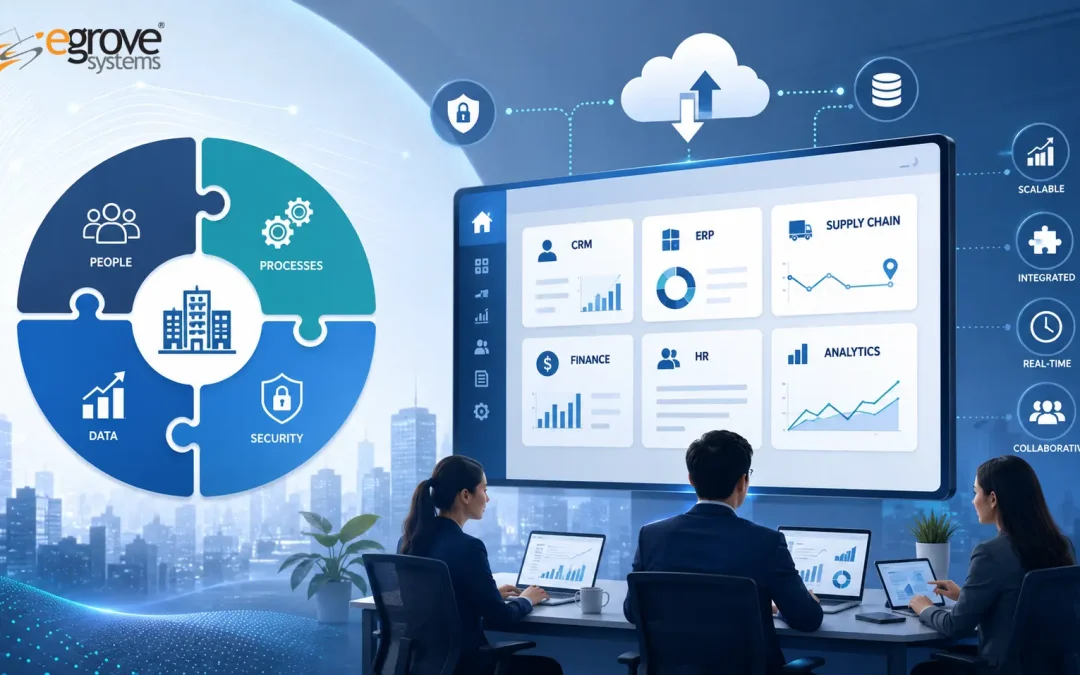
Modern businesses operate in an environment where speed, accuracy, collaboration, and data-driven decision-making determine success. As organizations grow, relying on disconnected software and manual processes becomes increasingly inefficient. Enterprise applications solve this challenge by integrating business operations into a unified, scalable, and secure digital ecosystem.
From customer relationship management (CRM) and enterprise resource planning (ERP) to supply chain management and workforce collaboration platforms, enterprise applications help organizations streamline operations, automate repetitive tasks, improve productivity, and gain real-time visibility into business performance.
Building an enterprise application is far more than developing software. It requires strategic planning, understanding business workflows, selecting the right technologies, ensuring security, enabling scalability, and creating a user-friendly experience that supports long-term business growth.
In this guide, we’ll explore what enterprise applications are, why businesses need them, the development process, technologies involved, challenges, and best practices for successful enterprise application development.
Why Enterprise Applications Matter
Today’s organizations generate enormous amounts of business data every day. Without a centralized platform, departments often work in isolation, leading to duplicated efforts, inconsistent information, delayed decision-making, and operational inefficiencies.
Enterprise applications eliminate these silos by creating a unified platform where employees, managers, and executives can access accurate information in real time.
Some of the major business benefits include:
- Improved operational efficiency
- Faster business processes
- Better customer experience
- Increased employee productivity
- Enhanced collaboration
- Improved reporting and analytics
- Regulatory compliance
- Higher data accuracy
- Reduced operational costs
- Better scalability
Organizations investing in enterprise applications are better positioned to adapt to changing market demands and digital transformation initiatives.
Key Characteristics of Enterprise Applications
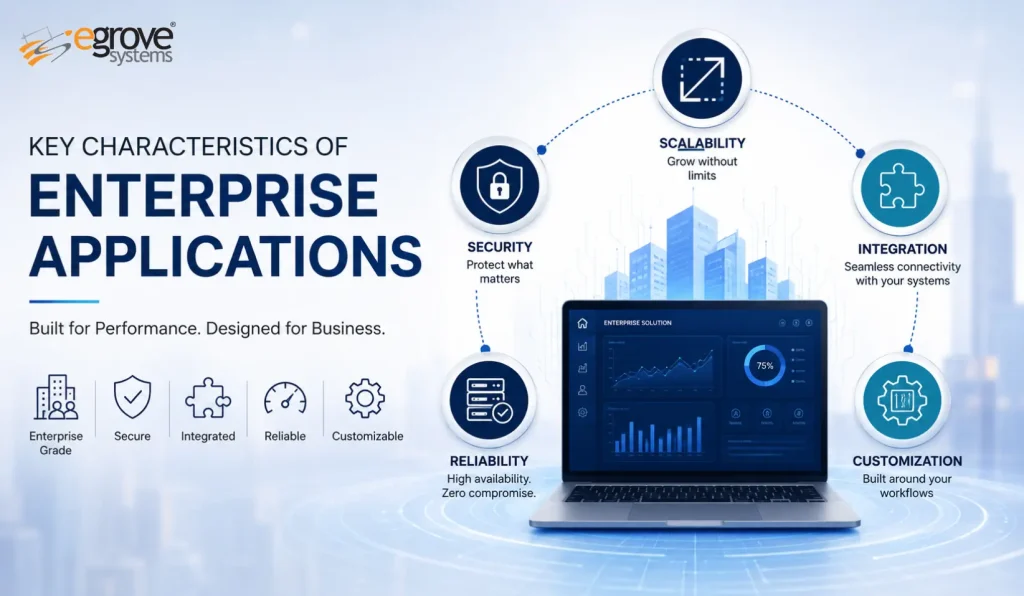
Enterprise software differs significantly from consumer applications. These solutions must support complex business operations while maintaining reliability and performance.
Scalability
Enterprise applications should handle increasing users, larger datasets, and expanding business operations without sacrificing performance.
Security
Since enterprise systems often store sensitive customer, financial, and operational data, they require advanced security features such as:
- Data encryption
- Role-based access control
- Multi-factor authentication
- Secure APIs
- Compliance management
- Regular security monitoring
Integration
Enterprise software must integrate seamlessly with existing business systems, including:
- ERP
- CRM
- Accounting software
- HR platforms
- Payment gateways
- Cloud services
- Third-party APIs
Reliability
Downtime can significantly impact business operations. Enterprise applications require high availability, backup strategies, disaster recovery planning, and continuous monitoring.
Customization
Every organization has unique workflows. Enterprise applications should provide flexible configurations that adapt to changing business requirements.
Types of Enterprise Applications
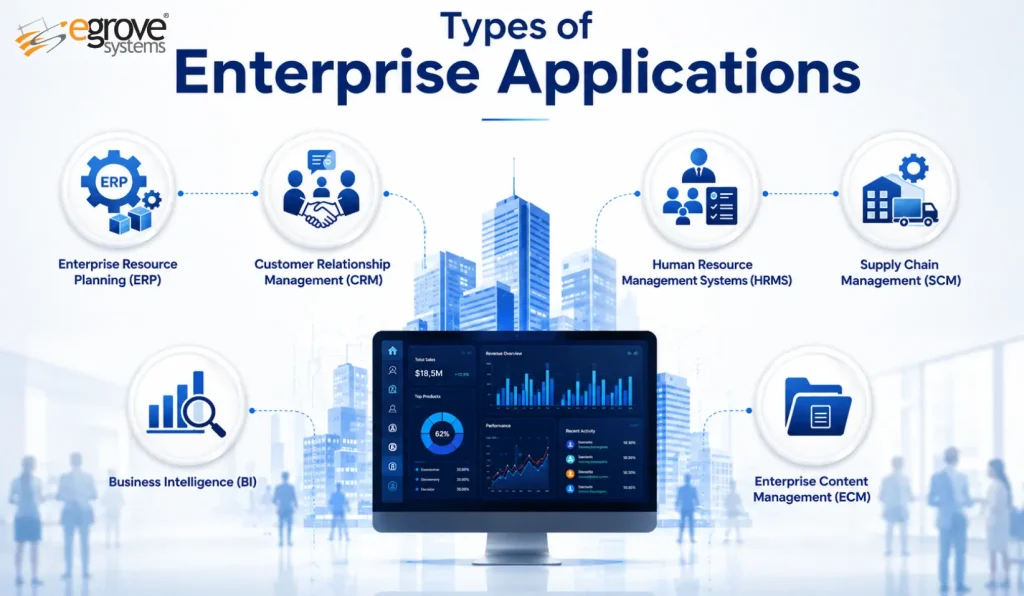
Organizations implement different enterprise solutions depending on their operational requirements.
Enterprise Resource Planning (ERP)
ERP systems integrate finance, procurement, inventory, manufacturing, sales, and operations into a single platform for centralized management.
Customer Relationship Management (CRM)
CRM applications help businesses manage customer interactions, sales pipelines, support services, and marketing campaigns.
Human Resource Management Systems (HRMS)
HRMS platforms simplify recruitment, payroll, employee records, attendance tracking, performance evaluations, and workforce management.
Supply Chain Management (SCM)
Supply chain applications improve procurement, inventory control, logistics, supplier management, and product distribution.
Business Intelligence (BI)
Business intelligence solutions analyze organizational data and generate actionable insights through dashboards, reports, and predictive analytics.
Enterprise Content Management (ECM)
These systems organize, store, manage, and secure digital documents while supporting collaboration across departments.
The Enterprise Application Development Process
Developing an enterprise application involves multiple structured phases that ensure the software aligns with business goals and operational requirements.
1. Business Requirement Analysis
The first step is understanding organizational challenges, business objectives, user expectations, and operational workflows.
This stage typically includes:
- Stakeholder interviews
- Workflow analysis
- Requirement gathering
- Risk assessment
- Business process documentation
Clear requirements help reduce development risks later in the project.
2. Solution Architecture
Once requirements are finalized, developers design the application’s architecture, selecting the appropriate technologies, infrastructure, databases, integrations, and deployment strategy.
Architecture planning determines how scalable, secure, and maintainable the application will be.
3. UI/UX Design
Enterprise applications should balance functionality with usability.
Designers create:
- Wireframes
- User journeys
- Interactive prototypes
- Responsive interfaces
- Dashboard layouts
A well-designed interface reduces employee training time and increases adoption.
4. Application Development
Developers build both frontend and backend components while implementing business logic, APIs, authentication, and integrations.
Modern development often follows Agile methodologies, enabling continuous improvements through iterative releases.
5. Quality Assurance
Testing ensures that every module performs as expected.
Testing includes:
- Functional testing
- Integration testing
- Performance testing
- Security testing
- User acceptance testing (UAT)
- Regression testing
6. Deployment
After successful testing, the application is deployed either on-premises, in the cloud, or within hybrid environments depending on organizational requirements.
7. Maintenance and Continuous Improvement
Enterprise software requires ongoing monitoring, updates, feature enhancements, and security patches to remain efficient and secure.
Technologies Used in Enterprise Application Development
Modern enterprise applications leverage advanced technologies to improve performance, flexibility, and user experience.
Common technologies include:
- Microsoft .NET
- Java
- Python
- Node.js
- Angular
- React
- Vue.js
- SQL Server
- PostgreSQL
- MySQL
- MongoDB
- Docker
- Kubernetes
- Microsoft Azure
- Amazon Web Services (AWS)
- Google Cloud Platform (GCP)
Cloud-native architectures have become increasingly popular because they support rapid deployment and scalability.
Challenges in Building Enterprise Applications
Despite the benefits, enterprise software development presents several challenges.
Complex Business Processes
Large organizations often have highly customized workflows that require detailed analysis and careful implementation.
Legacy System Integration
Many enterprises still operate legacy software that must integrate with modern applications without disrupting operations.
Security Risks
Handling sensitive enterprise data demands continuous monitoring, vulnerability assessments, and compliance with industry regulations.
Performance Optimization
Enterprise systems must maintain fast response times even during peak usage.
User Adoption
Employees may resist transitioning from familiar systems. Proper training and intuitive interfaces improve adoption rates.
Best Practices for Enterprise Application Development
Organizations can maximize project success by following proven development practices.
Focus on Business Objectives
Technology should solve real business problems rather than simply introducing new features.
Adopt Agile Development
Iterative development allows teams to gather feedback early and adapt quickly to changing requirements.
Prioritize Security
Implement security throughout the software development lifecycle instead of treating it as an afterthought.
Build for Scalability
Design applications that can accommodate future growth without requiring extensive redevelopment.
Enable Data Integration
Centralized data improves reporting accuracy, decision-making, and operational efficiency.
Monitor Application Performance
Continuous monitoring helps identify bottlenecks before they impact business operations.
Emerging Trends in Enterprise Application Development
Enterprise technology continues to evolve rapidly.
Some of the most significant trends include:
Artificial Intelligence
AI-powered automation, predictive analytics, intelligent search, and virtual assistants are becoming standard features in enterprise software.
Low-Code and No-Code Platforms
Organizations increasingly use low-code platforms to accelerate application development and reduce time to market.
Cloud-Native Applications
Cloud-first development improves scalability, disaster recovery, and infrastructure flexibility.
Internet of Things (IoT)
Connected devices generate valuable operational data that enterprise applications can analyze in real time.
Advanced Analytics
Businesses rely on predictive analytics and real-time dashboards to make informed strategic decisions.
Choosing the Right Enterprise Application Development Partner
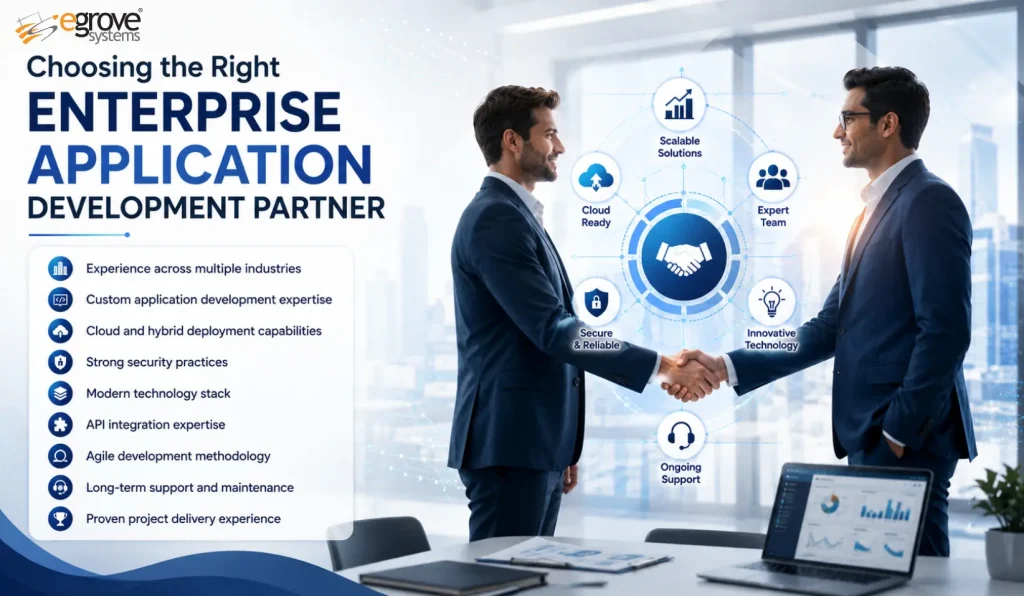
Selecting the right development partner is critical to project success.
Look for a provider that offers:
- Experience across multiple industries
- Custom application development expertise
- Cloud and hybrid deployment capabilities
- Strong security practices
- Modern technology stack
- API integration expertise
- Agile development methodology
- Long-term support and maintenance
- Proven project delivery experience
A reliable technology partner can help organizations reduce risks, optimize development timelines, and deliver scalable enterprise solutions that evolve with business needs.
Conclusion
Enterprise applications have become the foundation of modern digital businesses. They simplify operations, improve collaboration, enhance customer experiences, and provide organizations with the agility needed to compete in rapidly changing markets.
Successful enterprise application development requires more than writing code. It demands a deep understanding of business processes, strategic planning, secure architecture, seamless integrations, scalable technologies, and continuous optimization.
Whether you’re modernizing legacy systems, automating workflows, or building a new digital platform, investing in a well-designed enterprise application can improve efficiency, reduce operational costs, and support sustainable business growth. Partnering with an experienced enterprise application development company like eGrove Systems ensures your solution is tailored to your business objectives while delivering the performance, security, and scalability required for long-term success.
What is an Enterprise Application?
An enterprise application is a large-scale software solution designed to support an organization’s core business operations across multiple departments. Unlike standalone applications, enterprise applications integrate data, automate workflows, improve collaboration, and enable centralized management while supporting thousands of users, complex business rules, and high security standards.
Examples include:
- Enterprise Resource Planning (ERP)
- Customer Relationship Management (CRM)
- Human Resource Management Systems (HRMS)
- Supply Chain Management (SCM)
- Inventory Management Systems
- Financial Management Software
- Business Intelligence Platforms