

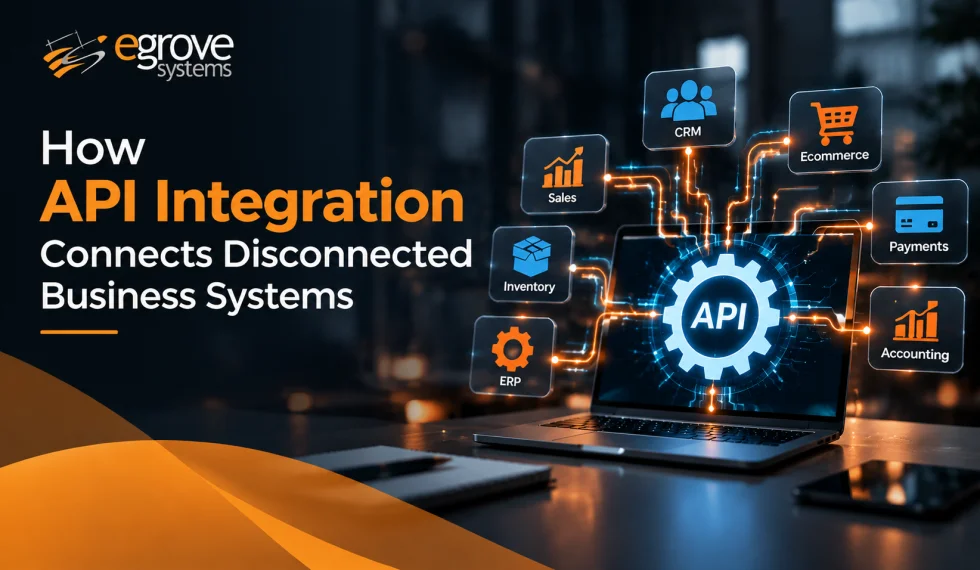
Modern businesses rely on multiple software systems for sales, finance, customer management, inventory, marketing, payments, and operations. While each system may perform its own function effectively, problems arise when these platforms cannot communicate with one another.
Employees end up transferring information manually, updating the same data in multiple places, and switching constantly between applications. API integration solves this problem by allowing different business systems to securely exchange data and work together.
What Is API Integration?
An API (Application Programming Interface) provides a structured way for one software application to communicate with another. API integration connects two or more applications so that information can move between them automatically.
For example, an e-commerce business might connect:
Online Store → Payment Gateway → Inventory System → CRM → Accounting Software
Instead of employees manually updating every platform after an order, APIs can synchronize the required information automatically.
Why Do Business Systems Become Disconnected?
As companies grow, they often introduce new applications to solve individual business requirements. Over time, this can create a fragmented technology environment.
Common problems include:
- Duplicate data across multiple platforms
- Manual data entry
- Outdated customer information
- Inventory mismatches
- Delayed reporting
- Repetitive administrative work
- Limited visibility across departments
These cases—they’re systems can slow operations and increase the possibility of human error.
The scale of this problem is well documented: recent industry research finds that the vast majority of organizations struggle to integrate data across their systems, with outdated infrastructure identified as the primary bottleneck blocking further digital transformation. For most companies, disconnected systems aren’t an edge case,they’re the default state.
How API Integration Connects Business Systems
Automated data exchange APIs allow information to move automatically between connected applications. When a customer places an online order, the API can send order details to the payment system, update inventory, create a customer record in the CRM, and pass transaction information to accounting software—reducing the need for employees to enter the same information repeatedly.
Creates Consistent Data Across Platforms When systems operate independently, the same customer or product information may differ across applications. API integration can synchronize data so connected systems receive updated information, helping businesses maintain more consistent records across departments.
Connects Existing and New Technologies Businesses don’t necessarily need to replace their existing software to improve connectivity. APIs can connect existing systems with newer applications, cloud platforms, mobile apps, AI services, and third-party solutions, allowing organizations to modernize their technology infrastructure gradually.
Improves Workflow Automation API integration can trigger actions automatically when specific events occur:
Customer submits an order → Payment is processed → Inventory is updated → Invoice is generated → Customer receives confirmation
Automating these workflows can reduce repetitive tasks and free employees to focus on higher-value work.
Provides Better Business Visibility When information is spread across disconnected platforms, creating a complete view of business performance can be difficult. APIs can consolidate information from different systems into centralized dashboards or reporting platforms, helping teams access more timely operational insights.
Common Business API Integrations
- CRM Integration—connecting websites, sales platforms, customer support systems, and marketing tools
- Payment Gateway Integration—connecting e-commerce platforms and applications with payment providers for secure transaction processing
- ERP Integration—synchronizing orders, inventory, finance, procurement, and operational information
- Ecommerce Integration—connecting online stores with shipping providers, inventory systems, marketplaces, and accounting platforms
- AI Integration—connecting business applications with AI services for automation, recommendations, analysis, and customer support
Business Benefits of API Integration
A well-planned API integration strategy can help organizations achieve reduced manual work, faster information exchange, improved data consistency, better workflow automation, easier integration with third-party platforms, improved operational visibility, and more scalable digital infrastructure.
Building a Connected Business Ecosystem
Disconnected applications create unnecessary complexity as a business grows. API integration provides the communication layer that allows different technologies to work together as part of a connected ecosystem.
At eGrove Systems, this shows up differently depending on the platform. For businesses running Elite mCommerce, it often means connecting storefronts to inventory, fulfillment, and payment systems so orders move without manual handling. For those using Elite Site Optimizer, it can mean linking site performance data with the broader marketing stack. Across SEVnest’s compliance and workforce tools and Class2Learn’s learning platform, the same principle holds—the value of any one system multiplies once it’s actually communicating with the systems around it.
Looking to connect your disconnected business systems?
Talk to eGrove Systems about where API integration could remove the most manual work first.