

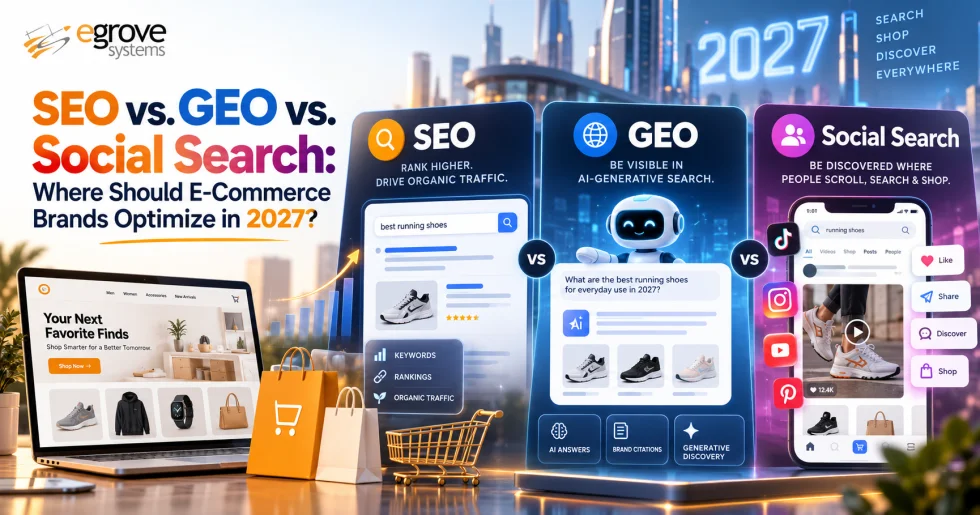
The way consumers discover products online is changing. A shopper looking for the best running shoes might begin with a Google search, ask an AI assistant for recommendations, or explore product reviews on Instagram, TikTok, and YouTube before making a purchase.
For e-commerce brands, this shift creates a new challenge: being visible across multiple search environments rather than relying on traditional search rankings alone.
Search Engine Optimization (SEO) continues to connect businesses with shoppers actively searching for products. Generative Engine Optimization (GEO) focuses on improving how brands and products are represented in AI-generated answers. Meanwhile, Social Search Optimization helps businesses reach consumers who use social platforms to discover products, compare experiences, and evaluate recommendations.
As brands prepare for 2027, the question is no longer whether SEO is enough. It is how to combine SEO, GEO, and Social Search into a strategy that supports product discovery, customer trust, and sales.
What Is the Difference Between SEO, GEO, and Social Search?
Although these approaches share the goal of improving visibility, they influence different stages of the customer journey.
| Factor | SEO | GEO | Social Search |
| Primary focus | Search engine visibility | AI-generated recommendations and citations | Discovery within social platforms |
| Key platforms | Google, Bing | Chat GPT, Gemini, Perplexity, and AI search experiences | Instagram, TikTok, YouTube, Pinterest |
| Content focus | Product pages, categories, blogs | Reliable product facts, comparisons, expert content | Short videos, tutorials, reviews |
| Customer intent | Finding specific information or products | Asking questions and comparing solutions | Exploring products and experiences |
| Main objective | Organic traffic and conversions | Visibility in AI-generated responses | Discovery, engagement, and purchase interest |
| Key measurements | Rankings, organic clicks, revenue | Brand mentions, citations, referral conversions | Search reach, engagement, referral sales |
The three approaches are interconnected. A well-optimized product page can support traditional search visibility while also providing information that AI search tools may use. Social content can introduce products to new audiences and generate branded searches.
Understanding these connections helps e-commerce businesses allocate resources without treating every search channel as a separate marketing activity.
1. SEO in 2027: Why Traditional Search Still Matters
Search Engine Optimization remains an essential foundation for e-commerce growth.
When customers search for phrases such as “buy organic skincare products,” “best wireless headphones under $100,” or “comfortable office chairs for home,” search engines help connect them with relevant product and category pages. These searches often reflect clear commercial intent, making SEO valuable for attracting potential customers who are already considering a purchase.
Key E-Commerce SEO Priorities
Product and category page optimization. Every important product and category page should contain descriptive titles, relevant product information, clear headings, and useful content. Brands should also avoid relying entirely on manufacturer descriptions that appear across multiple websites.
Technical website performance. Fast loading, mobile-friendly layouts, crawlable navigation, accessible content, and functional product pages contribute to a better shopping experience. They also depend on a solid foundation of e-commerce web development.
Product structured data. Relevant structured data, including Product, Offer, Aggregate Rating, and Breadcrumb List where applicable, helps search engines interpret product information. Eligibility for enhanced search appearances depends on the specific feature requirements.
Search intent alignment. Different searches require different page types. A customer searching for “best laptop for graphic design” may benefit from a buying guide, while someone searching for a specific laptop model may expect a detailed product page.
Content quality and authority. Original buying guides, product comparisons, expert explanations, and customer-focused resources can support visibility while helping visitors make confident purchasing decisions.
Why SEO Cannot Be Ignored
Even as AI-powered search develops, traditional search optimization supports the crawlability, discoverability, and usability of e-commerce websites.
A technically weak website can struggle to communicate accurate product information across multiple discovery channels. Therefore, SEO should remain a long-term investment rather than a strategy brands replace with emerging marketing trends.
2. GEO in 2027: Optimizing for AI-Generated Product Recommendations
Generative Engine Optimization (GEO) focuses on improving a brand’s discoverability and representation within AI-generated responses.
Instead of entering a short keyword, shoppers can ask detailed questions such as:
- “Which budget-friendly skincare products are suitable for sensitive skin?”
- “What are the best office chairs for someone working from home?”
- “Compare these three wireless earbuds based on battery life and comfort.”
- “Which sustainable clothing brands offer affordable everyday wear?”
AI systems may respond with explanations, comparisons, product suggestions, and links to supporting sources. For e-commerce brands, this creates opportunities to be considered when shoppers are researching products.
How E-Commerce Brands Can Improve GEO
Create clear, reliable product information. Product descriptions should communicate specifications, materials, dimensions, compatibility, availability, and other facts that help shoppers compare options.
Publish detailed product comparisons. Comparison articles that explain differences between products can answer complex shopping questions more effectively than promotional content alone.
Strengthen brand credibility. Consistent company information, transparent policies, expert contributions, genuine reviews, and credible third-party coverage help customers evaluate a business and may support its visibility across information sources.
Answer customer questions directly. Useful FAQs addressing product suitability, sizing, maintenance, shipping, warranties, and return policies make product information easier to understand.
Keep product data accurate. Inventory availability, pricing, shipping details, and product variations should remain consistent across the website and relevant shopping feeds.
Monitor AI search visibility. Brands can periodically test representative shopping queries in AI platforms to identify whether their products appear, how they are described, and which sources are cited.
However, GEO should not be treated as a collection of guaranteed ranking tricks. Google states that its existing SEO best practices remain relevant to AI features such as AI Overviews and AI Mode, and that no special schema.org markup is required to appear in them. You can read the details in Google Search Central’s guidance on AI features.
The GEO Opportunity for E-Commerce
AI-assisted product research could become an increasingly important part of the shopping journey in 2027. For example, a consumer planning to purchase a home air purifier might ask an AI assistant to compare filter types, maintenance costs, room coverage, and product reliability.
A brand offering detailed specifications, practical explanations, and reliable supporting information may be better positioned for discovery than one publishing only brief promotional descriptions.
Visibility is not guaranteed, and AI-generated recommendations can vary. The objective is to make the brand’s information accurate, useful, accessible, and easy to verify.
3. Social Search in 2027: Where Product Discovery Meets Customer Experience
Social Search refers to the process of finding products, services, recommendations, and information directly through social platforms.
Unlike traditional search, which often begins with a specific need, social discovery can start with a video, a creator recommendation, or a conversation around a product. A consumer searching for “minimalist bedroom decor” on Pinterest may discover a new furniture brand. Someone exploring “best everyday backpacks” on TikTok might watch several customer reviews before visiting an online store.
Social platforms increasingly support both intentional searches and interest-driven discovery. For a closer look at how this shift is affecting search, see our post on how TikTok, Reddit, and YouTube are changing SEO.
Social Search Optimization Strategies for E-Commerce
Use descriptive captions and titles. Social content should include natural product-related keywords that accurately explain what viewers will see.
Create product demonstration videos. Show products being used in realistic situations. Demonstrations can help shoppers evaluate functionality, appearance, quality, and suitability.
Encourage authentic user-generated content. Customer reviews, unboxing videos, tutorials, and experience-based posts can provide perspectives beyond a brand’s marketing claims.
Optimize platform profiles. Use clear business descriptions, consistent product categories, relevant profile information, and accessible shopping links.
Develop searchable content formats. Consider videos and posts based on questions such as “How to choose the right running shoes” or “Which kitchen storage containers save space?”
Track discovery and purchase behavior. Analyze profile visits, saves, engagement, product clicks, shopping sessions, and attributed conversions rather than measuring success through views alone.
Why Social Search Matters for Online Retailers
Social Search introduces products through visual demonstrations and real-world experiences. For categories such as fashion, beauty, home decor, fitness equipment, and lifestyle accessories, these formats can communicate product value quickly.
However, the impact varies by target audience and product category. A B2B equipment seller may gain more qualified demand from Google and specialist content than from viral short-form videos. The most effective social strategy follows customer behavior rather than platform popularity.
4. SEO vs. GEO vs. Social Search: Which Should E-Commerce Brands Prioritize?
Quick definitions: SEO earns visibility in search engine results. GEO earns citations and recommendations in AI-generated answers. Social Search earns discovery inside platforms such as TikTok, Instagram, YouTube, and Pinterest.
The right investment depends on what a business sells, where its customers search, and the maturity of its digital presence.
Prioritize SEO when customers already search for your products. This is particularly valuable for retailers with established product categories, detailed catalogs, and clear purchase-intent keywords.
Expand GEO when customers need comparisons and detailed answers. This approach is relevant for products requiring research, technical evaluation, or guidance before purchase.
Strengthen Social Search when visuals and experiences influence demand. This can be valuable for products that benefit from demonstrations, lifestyle content, and creator-led discovery.
These priorities are not mutually exclusive. For example, a skincare brand could use SEO to rank its moisturizer category pages, GEO to support discovery for questions about skin types, and Social Search to demonstrate product application and customer experiences. Together, these channels provide multiple opportunities to connect with customers before they purchase.
5. Building an Integrated E-Commerce Search Strategy for 2027
Instead of competing for the same marketing budget, SEO, GEO, and Social Search can reinforce one another. A practical strategy begins with understanding the customer journey.
Step 1: Identify how customers discover products. Analyze search queries, social platform insights, customer questions, website analytics, and product-level conversion data. Determine whether customers primarily discover products through direct searches, detailed research, recommendations, or visual inspiration.
Step 2: Build a strong SEO foundation. Review website crawlability, indexing, navigation, performance, structured data, product content, and mobile usability. Resolve technical problems that prevent customers or search engines from accessing essential product information.
Step 3: Develop content for search and AI discovery. Create original product comparisons, buying guides, explanatory articles, and clear FAQs. Support claims with accurate specifications, first-hand experience where possible, and trustworthy information. Our e-commerce blogging blueprint shows how to turn content into traffic, trust, and sales.
Step 4: Repurpose valuable content for social platforms. Transform buying guides into short tutorials, product comparisons into carousel posts, and frequently asked questions into educational videos. Maintain consistent product facts and brand messaging across channels while adapting presentation to each platform.
Step 5: Connect discovery with conversion. Make the transition from content to product pages simple. Ensure that social visitors and search users can find pricing, product options, delivery details, and checkout information without unnecessary friction.
Step 6: Measure performance across channels. Track outcomes that reflect business value rather than relying on visibility alone.
| Channel | Recommended KPIs |
| SEO | Organic impressions, clicks, product page traffic, conversions, organic revenue |
| GEO | AI brand mentions, cited URLs, AI referral sessions, assisted conversions |
| Social Search | Search-driven reach, product clicks, saves, referral traffic, attributed revenue |
| Overall | Customer acquisition cost, conversion rate, repeat purchases, total revenue |
AI visibility tracking should be interpreted carefully because results vary by platform, query, location, and time. Not every AI mention leads to a measurable website visit.
6. How Should E-Commerce Brands Allocate Their Marketing Efforts?
There is no universal budget allocation that works for every retailer. However, businesses can use a starting framework to test investment across discovery channels.
| Channel | Illustrative share of effort |
| SEO | 50% |
| GEO | 25% |
| Social Search | 25% |
This is an illustrative starting allocation, not an industry benchmark. It gives priority to core SEO while reserving resources for AI and social discovery experiments.
A new online store may need a larger initial technical SEO investment. A visually driven consumer brand might allocate more effort to social content. A retailer selling complex products may benefit from additional comparison content and AI visibility monitoring. Review performance regularly and shift resources toward channels generating qualified visitors, customers, and revenue.
7. Common Mistakes E-Commerce Brands Should Avoid in 2027
Adopting new discovery channels without a coordinated plan can lead to wasted effort.
Treating GEO as a replacement for SEO. AI visibility depends partly on accessible, credible information. Weak product pages and technical website problems should not be overlooked in favor of speculative AI optimization techniques.
Publishing the same content everywhere. A detailed buying guide, a short video, and an AI-friendly product comparison serve different purposes. Each format should match the needs of its intended audience.
Prioritizing traffic without conversion quality. High impressions or video views do not necessarily translate into sales. Businesses should measure whether visitors take meaningful actions.
Using outdated product information. Conflicting prices, incorrect availability, and incomplete specifications can damage customer confidence and create confusion across discovery platforms.
Ignoring customer questions and reviews. Real customer concerns often reveal opportunities for product FAQs, educational articles, demonstrations, and comparison content.
Avoiding these mistakes allows businesses to establish a more reliable and sustainable digital presence.
8. What Will E-Commerce Search Look Like in 2027?
Several developments are likely to influence how brands approach online discovery, although exact adoption rates and platform capabilities remain uncertain.
More conversational product research. Customers may increasingly ask detailed questions instead of relying exclusively on short keyword searches. Brands will need content that explains products in context.
Greater importance of accurate product data. Clear specifications, current pricing, product availability, and consistent shopping information will remain important as search experiences become more automated.
Stronger connections between content and commerce. Educational articles, AI-assisted research, creator recommendations, and product pages may become more interconnected during shopping journeys.
More emphasis on authentic expertise. Original product testing, transparent comparisons, credible reviews, and genuine user experiences may help businesses distinguish themselves from repetitive or low-value content.
Evolving measurement methods. Marketing teams will need to evaluate visibility beyond conventional rankings while continuing to connect channel performance to commercial outcomes.
For 2027, the strongest approach is to prepare for these developments without assuming that every emerging feature will become a dominant shopping channel.
Tools That Can Support Your Strategy
Executing across three discovery channels is easier when your storefront and optimization tools work together. Elite mCommerce is e Grove’s mobile commerce app builder, helping stores deliver a mobile app experience to shoppers who arrive from search, AI answers, or social platforms. Elite Site Optimizer (ESO) can play a supporting role in your SEO and GEO work by helping teams audit site health and track search and AI citation visibility. Neither replaces a sound strategy, but both can make it easier to run day to day.
Conclusion: The Future of E-Commerce Search Is Multi-Channel
SEO, GEO, and Social Search address different aspects of modern product discovery. SEO helps customers find relevant products through traditional search engines. GEO focuses on the information that AI-powered experiences may use to explain, compare, and recommend options. Social Search brings product discovery closer to demonstrations, customer experiences, and online communities.
For e-commerce brands planning their 2027 strategies, the best approach is not choosing one channel over the others. It is building a connected search presence that supports discovery, evaluation, and conversion. Start with strong website optimization, expand into useful and credible content for AI-assisted research, and invest in social platforms where your customers actively discover products.
At eGrove Systems, we help e-commerce businesses connect strategy and technology, from commerce development and mobile experiences to digital marketing and AI-ready content. If you are planning where to focus your 2027 optimization budget, our team can help you build a roadmap that fits your catalog, customers, and goals.
Talk to eGrove Systems about your 2027 e-commerce growth strategy