


For years, SEO focused heavily on keywords, backlinks, and technical performance. But search is changing fast. With AI-driven search engines, semantic understanding, and user-first ranking systems, one factor is becoming increasingly influential: brand voice consistency.
Today, search engines don’t just evaluate what you say. They evaluate how consistently and clearly your brand says it across the web. This shift means brand voice is no longer just a marketing or branding concern; it is quietly becoming a ranking signal.
In this article, we’ll explore what brand voice means in an SEO context, why it matters more than ever in 2026, and how it directly impacts visibility, trust, and rankings.
What Is Brand Voice in SEO Terms?

Brand voice is the consistent personality, tone, and communication style your brand uses across all content channels. It includes:
- Word choice and vocabulary style
- Tone (formal, conversational, technical, friendly)
- Messaging consistency across platforms
- Emotional positioning (trust, authority, innovation, empathy)
From an SEO perspective, brand voice helps search engines identify:
- Whether content belongs to a single authoritative entity
- Whether a brand demonstrates expertise and consistency
- Whether user intent is being satisfied reliably across content
Modern search algorithms, especially those powered by AI systems like Google’s helpful content systems and generative search experiences, are increasingly focused on entity-based understanding rather than isolated keyword matching.
That means your brand is not just a website; it is an entity. And brand voice is one of the strongest signals defining that entity.
Why Brand Voice Matters More in 2026
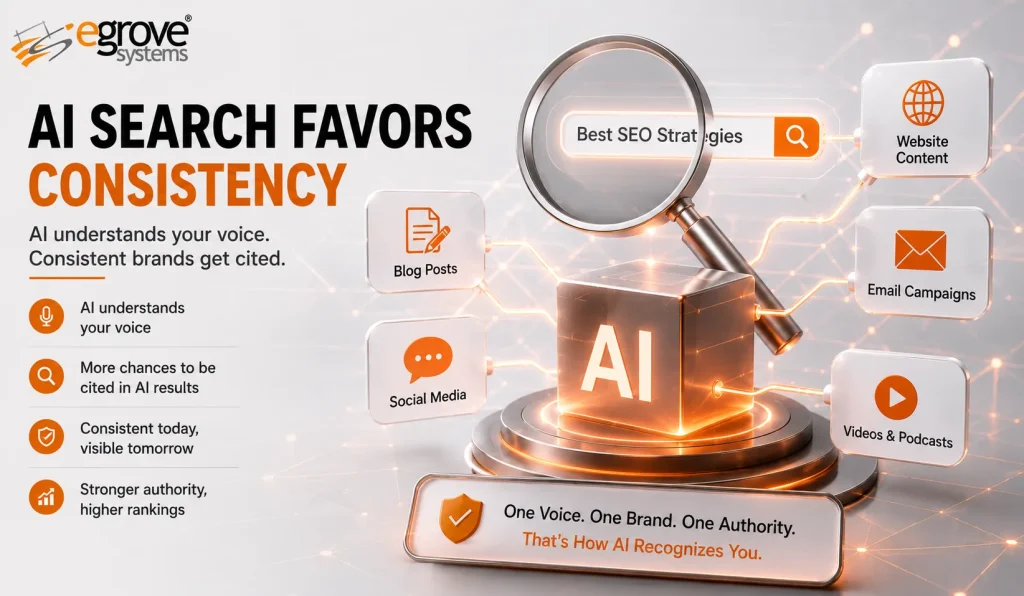
Search engines have evolved significantly. Here’s what changed:
1. Search is now entity-first, not keyword-first
Google and AI search engines understand brands as entities. They connect your blog, social media, product pages, and mentions across the web.
If your tone, messaging, and positioning vary too much, it weakens entity clarity.
2. AI-generated content increased noise
With AI content production increasing dramatically, search engines now prioritize the following:
- Authenticity
- Consistency
- Originality of voice
Generic content is easier to detect and downgrade.
3. User behavior signals matter more
Search engines analyze:
- Dwell time
- Click behavior
- Return visits
- Engagement patterns
A strong, recognizable brand voice improves engagement because users feel familiarity and trust.
4. Brand trust is a ranking multiplier
Trust is no longer just E-E-A-T (Experience, Expertise, Authority, Trust). It is becoming a measurable consistency factor.
Brands that sound different every time lose credibility signals.
How Brand Voice Influences SEO Rankings
Let’s break down the direct and indirect SEO impact.
1. Improves Topical Authority
Consistent brand voice reinforces topical expertise. When your tone, terminology, and messaging remain stable, search engines recognize you as a reliable source in a niche.
For example:
- A cybersecurity brand consistently using precise, technical language builds authority faster
- A lifestyle brand using inconsistent tones weakens its identity
2. Strengthens Entity Recognition
Search engines link content across platforms to form an entity graph.
Consistent brand voice helps algorithms confirm:
- “This content belongs to the same brand.”
- “This brand consistently publishes about X topic.”
- “This entity is stable and reliable.”
The approach improves indexing strength and ranking stability.
3. Enhances Content Relevance Scoring
Modern algorithms evaluate content quality based on semantic alignment.
If your brand voice consistently uses aligned vocabulary, structure, and intent, your content becomes easier to
- Categorize
- Cluster
- Rank under topic groups
4. Boosts Engagement Signals
Users subconsciously trust brands that “sound familiar.”
A consistent voice leads to the following:
- higher click-through rates (CTR)
- better on-page engagement
- lower bounce rates
These are indirect but powerful ranking signals.
5. Reduces Algorithmic Confusion
If your website alternates between:
- formal corporate tone
- casual blog tone
- overly technical whitepaper tone
Search engines struggle to define your brand identity.
That confusion weakens ranking consistency.
Brand Voice vs Keyword Optimization
A major misconception in SEO is that keywords alone drive rankings. In reality:
Keywords bring visibility, but brand voice builds trust and retention.
Here’s the difference:
| SEO Element | Purpose | Impact |
| Keywords | Discovery | Helps pages get indexed |
| Backlinks | Authority | Builds external validation |
| Brand Voice | Identity | Builds long-term ranking stability |
In 2026 SEO, brand voice acts like a layer above keywords, shaping how content is interpreted.
How AI Search Engines Interpret Brand Voice
AI-powered search systems (like Google SGE and other generative engines) don’t just read pages; they summarize and interpret them.
They evaluate:
- Tone consistency across content
- Clarity of explanations
- Linguistic patterns
- Emotional reliability
If your brand consistently explains topics in a structured, authoritative tone, AI systems are more likely to
- Cite your content
- Include your brand in summaries
- Rank your pages for conversational queries
This is why brand voice now affects AI visibility, not just traditional SEO rankings.
The Link Between Brand Voice and User Intent Satisfaction
Search engines aim to satisfy intent. Brand voice plays a major role in this.
For example:
- A user searching “how to fix website SEO issues” expects clarity, not marketing fluff
- A user searching “enterprise AI solutions” expects structured, professional insight
If your brand voice matches intent:
- users stay longer
- content feels relevant
- trust increases
This alignment improves ranking stability over time.
Common Brand Voice Mistakes That Hurt SEO
1. Inconsistent tone across pages
Landing pages sound corporate, blogs sound casual, and product pages sound technical.
2. Over-optimization for keywords
Forcing keywords breaks natural tone and reduces readability.
3. Generic AI-written content
Content that lacks personality signals weak brand identity.
4. Mixing multiple messaging styles
Trying to appeal to everyone often results in appealing to no one.
How to Build a Brand Voice That Improves SEO

1. Define your brand personality clearly
Choose 3-5 attributes:
- Authoritative
- Innovative
- Conversational
- Technical
- Empathetic
Stick to them across all content.
2. Create a tone guideline system
Define:
- Sentence structure style
- Vocabulary rules
- Preferred terms
- Words to avoid
3. Align content across all platforms
Ensure your:
- Website
- Blogs
- Emails
- Social media
all reflect the same voice identity.
4. Train AI content tools with your tone
If you use AI for content creation, feed structured brand voice prompts to maintain consistency.
5. Audit content regularly
Check:
- Tone drift
- Inconsistency in messaging
- Deviation from core identity
The Future: Brand Voice as a Measurable SEO Factor

We are moving toward a search ecosystem where:
- Entities matter more than pages
- Consistency matters more than volume
- Trust matters more than backlinks alone
In that future, brand voice will likely become the following:
- A ranking multiplier
- An AI citation factor
- A trust-based scoring input
Search engines want predictable, reliable, and authoritative sources. Brand voice is how that reliability is communicated.
2026 SEO Trend Insight
🔍 Brand Voice Consistency Index (BVCI)
A rising concept in AI SEO systems where search engines evaluate how consistently a brand communicates across its digital ecosystem.
Key signals analyzed:
- Tone consistency across blog, social, and website content
- Semantic alignment of messaging across pages
- Repetition of core brand terms and phrases
- User engagement with branded content
Why it matters:
Brands with high consistency scores are more likely to:
-
Appear in AI-generated search summaries
-
Rank for non-branded informational queries
-
Gain stronger entity recognition
-
Improve topical authority faster
How eGrove Systems Aligns With This Shift
At eGrove Systems, digital strategies are evolving beyond traditional SEO.
Modern optimization focuses on:
- AI-ready content structure
- Brand consistency across platforms
- Technical SEO + semantic SEO integration
- AI visibility optimization (AEO + GEO)
- Conversion-focused storytelling
This ensures brands don’t just rank; they become recognizable entities in AI search ecosystems.
Conclusion
Brand voice is no longer just about storytelling or marketing personality. It is becoming a foundational SEO layer that influences how search engines understand, categorize, and rank your content.
In 2026 and beyond, winning in search will not only depend on what you publish but also on how consistently your brand speaks across every digital touchpoint.
Strong SEO is no longer just technical optimization. It is identity optimization.