
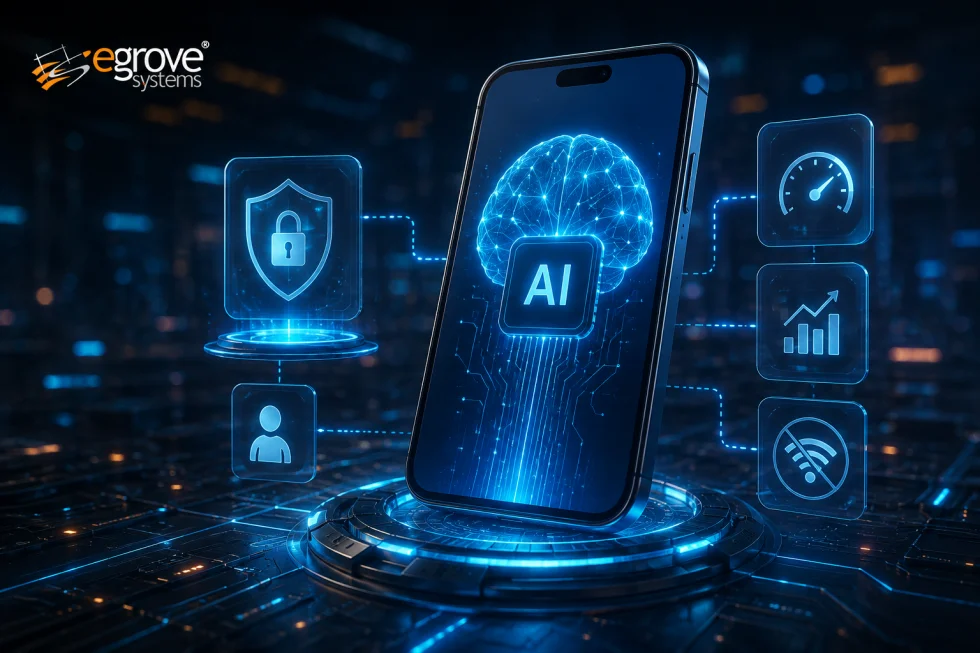
Artificial intelligence is transforming mobile applications by enabling personalized experiences, intelligent recommendations, automated processes, and faster interactions. Traditionally, mobile apps have relied on cloud-based AI to process information and generate responses. However, growing concerns about data privacy, internet dependency, and processing delays are driving businesses toward a more efficient approach known as On-Device AI.
On-Device AI in mobile apps enables artificial intelligence models to process information directly on smartphones and tablets instead of sending every request to external servers. This approach helps businesses deliver smarter, faster, and more privacy-focused experiences through modern mobile app development.
What Is On-Device AI in Mobile Apps?
On-Device AI refers to the integration of artificial intelligence and machine learning models directly into mobile devices. These models perform tasks using the device’s processing capabilities, including CPUs, GPUs, and Neural Processing Units (NPUs).
Unlike traditional cloud-based AI, On-Device AI can analyze information, recognize patterns, and generate results locally without requiring continuous communication with remote servers.
Common examples include:
- Intelligent product recommendations
- Facial recognition and biometric authentication
- Real-time language translation
- Voice recognition
- AI-powered image and visual search
- Predictive text and smart replies
- Personalized content recommendations
- Intelligent document scanning
These capabilities allow businesses to develop intelligent mobile applications while reducing their dependence on cloud infrastructure.
How Does On-Device AI Work?
On-Device AI uses optimized machine learning models designed to operate within the hardware and resource limitations of mobile devices. The process typically involves collecting input from users, processing the information through a locally deployed AI model, and generating relevant results directly within the application.
Technologies such as Apple Core ML, Google LiteRT (formerly TensorFlow Lite), ONNX Runtime Mobile, and mobile neural processing units help developers integrate AI capabilities into Android and iOS applications.
Techniques such as model quantization, pruning, and knowledge distillation can help reduce model size and computational requirements while maintaining acceptable accuracy.
Key Benefits of On-Device AI in Mobile Apps
1. Enhanced Data Privacy and Security
One of the biggest advantages of On-Device AI is its ability to process sensitive information locally. Personal details, images, voice recordings, and user behavior can remain on the device when cloud processing is unnecessary.
This reduces unnecessary data transmission and helps businesses build greater customer trust. However, secure storage, access controls, encryption, and appropriate data management practices remain essential.
2. Faster Performance and Real-Time Responses
Cloud-based AI applications may experience delays due to network connectivity and server response times. On-Device AI reduces network-related latency by processing information directly on mobile devices. This enables faster interactions for features such as visual search, object recognition, predictive text, and biometric authentication.
3. Offline Functionality
Mobile applications powered by On-Device AI can perform supported intelligent tasks without an active internet connection. This is particularly beneficial for healthcare, education, travel, retail, and field service applications where reliable internet connectivity may not always be available.
4. Reduced Cloud Infrastructure Costs
Processing AI tasks locally can reduce the number of API requests, server workloads, and cloud computing requirements. Businesses with large mobile application user bases can potentially lower operational expenses while maintaining efficient AI-powered experiences.
5. Improved Personalization
On-Device AI can analyze locally available user preferences, browsing behavior, and interaction patterns to deliver personalized experiences. Mobile applications can provide relevant recommendations, customized content, and intelligent suggestions while minimizing the need to transfer personal information to external systems.
Quick definition: inference. Inference is the step where a trained AI model produces a result from new input, such as recognizing a face or suggesting the next word. On-Device AI runs inference locally on the phone, while the model itself is typically still trained elsewhere and then delivered to the device inside the app.
On-Device AI vs. Cloud-Based AI
| Feature | On-Device AI | Cloud-Based AI |
| Data processing | Within the mobile device | Remote cloud servers |
| Internet dependency | Low for supported tasks | Generally high |
| Response time | Low network-related latency | Depends on network and server performance |
| Data privacy | Greater local data control | Requires secure data transmission |
| Offline functionality | Supported | Generally limited |
| Cloud operating costs | Potentially lower | Usage-dependent |
| Model complexity | Limited by device capabilities | Supports larger, more complex models |
| Model updates | Requires device-side updates | Centrally managed |
Many businesses can benefit from a hybrid AI approach that combines local processing for privacy-sensitive and time-critical tasks with cloud-based AI for more complex operations.
Real-World Applications of On-Device AI
eCommerce and Retail
On-Device AI can enhance mobile shopping experiences through intelligent product recommendations, visual product search, personalized offers, and smart shopping assistance. Retail businesses can provide more responsive shopping experiences while reducing unnecessary transmission of customer information. For teams deciding where an app fits alongside other storefront options, this comparison of a mobile app, PWA, or responsive store is a useful starting point.
Healthcare
Healthcare applications can use On-Device AI for health monitoring, activity recognition, document scanning, and preliminary pattern detection. Local processing can help protect sensitive health information while supporting timely insights. Clinical applications still require appropriate validation and regulatory compliance.
Banking and Finance
Financial applications can leverage On-Device AI for biometric authentication, suspicious activity detection, document recognition, and personalized financial insights. Local processing can strengthen privacy by reducing the need to transmit certain sensitive information.
Education and eLearning
AI-powered educational applications can deliver personalized learning recommendations, adaptive assessments, language translation, and speech recognition. Offline AI capabilities can also support students in areas with limited internet connectivity.
Travel and Hospitality
Travel applications can use On-Device AI for real-time translation, intelligent travel recommendations, image recognition, and offline assistance, making mobile experiences more convenient.
Enterprise Mobile Applications
Businesses can integrate On-Device AI into enterprise applications for intelligent document processing, inventory recognition, workflow automation, and field service assistance. These capabilities help improve employee productivity and operational efficiency.
Technologies Driving On-Device AI Development
Several technologies are enabling developers to build intelligent mobile applications.
| Technology | Purpose |
| Apple Core ML | Integrates machine learning models into iOS applications |
| Google LiteRT | Enables efficient AI model inference on mobile and edge devices |
| Google ML Kit | Provides mobile-ready machine learning capabilities |
| ONNX Runtime Mobile | Supports optimized cross-platform AI model execution |
| Neural Processing Units | Accelerates AI computations using dedicated hardware |
| MediaPipe | Supports real-time vision, audio, and machine learning tasks |
| Model Quantization | Reduces AI model size and computational requirements |
| Federated Learning | Supports distributed model training without centralizing raw training data |
Challenges of Implementing On-Device AI
Although On-Device AI offers significant advantages, businesses must consider several development challenges:
- Limited memory and processing capabilities on older devices
- Battery consumption during intensive AI operations
- AI model size and application storage requirements
- Compatibility across different mobile devices
- AI model accuracy and performance optimization
- Secure model deployment and regular updates
- Protection against unauthorized access and model manipulation
An effective mobile app development strategy should balance AI performance, device compatibility, security, and user experience. Choosing between native, cross-platform, and low-code builds is part of that decision, and this guide to the right mobile app development approach in 2026 can help.
Best Practices for Developing On-Device AI Mobile Apps
Businesses should follow these best practices to maximize the effectiveness of On-Device AI:
- Select lightweight and optimized AI models
- Use hardware acceleration wherever available
- Implement privacy-by-design principles
- Optimize battery consumption and memory utilization
- Test AI performance across multiple devices
- Provide transparent user consent and privacy controls
- Adopt hybrid AI architecture when appropriate
- Regularly monitor and update AI models
- Encrypt sensitive information stored on devices
- Implement fallback mechanisms for unsupported devices
The Future of On-Device AI in Mobile Applications
As mobile processors become more powerful and AI models become increasingly efficient, On-Device AI is expected to play a major role in next-generation mobile application development. Emerging opportunities include:
- On-device generative AI
- Intelligent personal assistants
- Small language models (SLMs)
- Real-time multimodal AI
- AI-powered augmented reality
- Privacy-focused predictive analytics
- Context-aware mobile experiences
- Intelligent workflow automation
Businesses adopting these technologies can create more responsive, personalized, and privacy-conscious digital experiences while reducing unnecessary cloud dependency. To see how generative AI is already reshaping everyday workflows, read Beyond Chatbots: Generative AI Applications for Everyday Business Workflows.
Intelligent Mobile Commerce with Elite mCommerce
For retailers, a mobile app is often the most direct way to deliver fast, personalized shopping. Elite mCommerce (EMC) is eGrove’s AI-enhanced mobile app builder that helps Magento and WordPress store owners turn their eCommerce store into an iOS and Android app. It supports customer engagement features such as push notifications, loyalty programs, and personalized alerts, giving retail brands a purpose-built foundation for the intelligent, privacy-conscious experiences described above.
Conclusion
On-Device AI in mobile apps represents a significant advancement in artificial intelligence and mobile technology. By processing information directly on devices, businesses can deliver faster responses, enhanced privacy, offline functionality, and personalized user experiences. As demand for intelligent, privacy-focused applications continues to grow, adopting On-Device AI can help businesses remain competitive and build stronger customer relationships.
eGrove Systems helps businesses combine mobile application development with AI and machine learning solutions, from AI-powered eCommerce apps and enterprise mobile solutions to personalized customer experiences and intelligent automation. By pairing On-Device AI, cloud-based intelligence, and scalable mobile architectures, we build applications that prioritize performance, security, and customer satisfaction.
Ready to transform your business with AI-powered mobile apps? Talk to the eGrove Systems team about your next project.