

Artificial Intelligence (AI) has evolved rapidly over the past decade. From predictive analytics and recommendation engines to conversational AI assistants, businesses have embraced AI to automate tasks, improve customer experiences, and make data-driven decisions. Today, a new advancement is redefining enterprise automation Agentic AI.
Unlike conventional AI systems that simply respond to user inputs, Agentic AI is designed to act independently, make decisions, plan multiple steps ahead, and complete complex tasks with minimal human intervention. It combines reasoning, planning, memory, and execution to function as an intelligent digital agent capable of achieving defined objectives.
As organizations continue investing in digital transformation, Agentic AI is emerging as a critical technology for improving operational efficiency, accelerating decision-making, and automating end-to-end business processes.
In this article, we’ll explore what agentic AI is, how it differs from traditional AI and generative AI, its core capabilities, business benefits, and why it is becoming an essential part of modern enterprise AI strategies.
What Is Agentic AI?
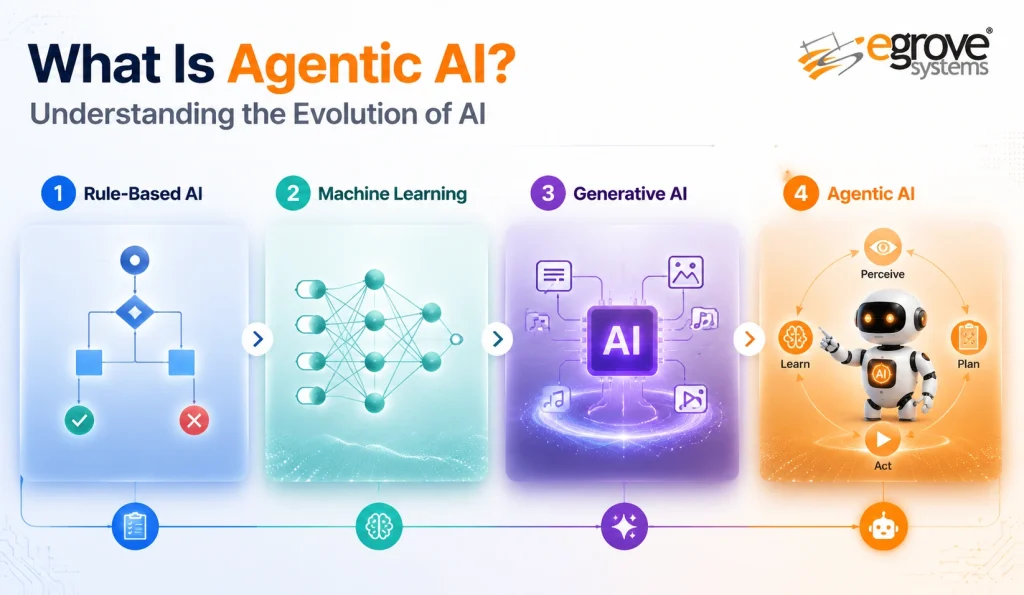
Agentic AI refers to AI systems that can independently perceive information, reason through problems, make decisions, execute actions, and continuously adapt to changing environments while working toward a specific objective.
Unlike traditional AI models that wait for individual prompts, Agentic AI can:
- Understand goals
- Break large objectives into smaller tasks
- Decide the best sequence of actions
- Use external tools and applications
- Monitor progress
- Adjust strategies when conditions change
- Complete workflows with minimal human involvement
Instead of functioning as a chatbot that answers one question at a time, Agentic AI behaves more like an intelligent digital employee capable of managing ongoing tasks.
For example, instead of simply answering questions about customer support, an Agentic AI system can:
- Retrieve customer information
- Analyze previous interactions
- Create a support ticket
- Schedule follow-ups
- Notify relevant teams
- Update CRM records
- Generate reports
all within a single workflow.
Understanding the Evolution of AI
To understand Agentic AI, it helps to see how artificial intelligence has evolved.
Rule-Based AI
The earliest AI systems followed predefined rules.
Characteristics include:
- Fixed decision trees
- Limited adaptability
- Manual programming
- Predictable outcomes
These systems worked well for repetitive tasks but struggled with unexpected situations.
Machine Learning
Machine learning introduced the ability for systems to learn from data rather than relying solely on manually coded rules.
Capabilities include:
- Pattern recognition
- Predictions
- Classification
- Recommendation systems
- Fraud detection
However, machine learning models generally perform a single specialized task rather than managing complete workflows.
Generative AI
Generative AI expanded AI capabilities by enabling systems to create new content.
Examples include:
- Text generation
- Image generation
- Code generation
- Audio creation
- Document summarization
Large Language Models (LLMs) like GPT have significantly improved how businesses interact with AI.
Despite these advances, Generative AI is generally reactive; it responds to prompts rather than proactively executing multi-step objectives.
Agentic AI
Agentic AI represents the next stage of AI evolution.
Instead of simply generating responses, Agentic AI can:
- Plan
- Decide
- Act
- Learn from outcomes
- Continue executing until objectives are achieved
This shift transforms AI from an assistant into an autonomous problem solver.
Key Characteristics of Agentic AI
Several capabilities distinguish Agentic AI from previous generations of artificial intelligence.
1. Goal-Oriented Decision Making
Traditional AI responds to instructions.
Agentic AI works toward achieving broader objectives.
Rather than requiring detailed prompts for every step, users define the desired outcome, and the AI determines how to accomplish it.
For example:
Objective:
“Prepare a monthly sales performance report.”
Instead of only generating text, Agentic AI can:
- Collect CRM data
- Analyze trends
- Create visualizations
- Summarize findings
- Email stakeholders
- Archive reports
2. Autonomous Planning
One of Agentic AI’s most important capabilities is planning.
It can:
- Divide projects into subtasks
- Prioritize activities
- Determine execution order
- Optimize workflows
This reduces manual coordination and accelerates business operations.
3. Multi-Step Reasoning
Many business tasks require several interconnected decisions.
Agentic AI performs reasoning across multiple stages instead of handling isolated requests.
Examples include:
- Diagnosing technical issues
- Processing insurance claims
- Managing procurement workflows
- Supply chain optimization
- Financial forecasting
Each decision influences the next step, allowing the AI to complete sophisticated processes.
4. Tool and Application Integration
Agentic AI does not operate in isolation.
It can connect with:
- CRM platforms
- ERP software
- Email systems
- Cloud storage
- Business intelligence tools
- Customer support applications
- Internal databases
- APIs
By interacting with enterprise systems, Agentic AI can execute real business operations instead of merely providing recommendations.
5. Memory and Context Awareness
Unlike many traditional AI systems that process requests independently, Agentic AI maintains context throughout ongoing workflows.
It remembers:
- Previous decisions
- Project status
- Customer interactions
- Workflow history
- Business rules
This enables more consistent, personalized, and efficient decision-making.
Agentic AI vs Traditional AI
Although both fall under the umbrella of artificial intelligence, their capabilities differ significantly.
| Feature | Traditional AI | Agentic AI |
| Response Style | Reactive | Proactive |
| Planning | Limited | Advanced |
| Multi-Step Tasks | Minimal | Extensive |
| Decision Making | Rule-based | Dynamic |
| Workflow Execution | Partial | End-to-end |
| Adaptability | Moderate | High |
| Human Intervention | Frequent | Minimal |
Traditional AI focuses on completing individual tasks, while Agentic AI is designed to manage complete workflows with greater autonomy.
Agentic AI vs Generative AI
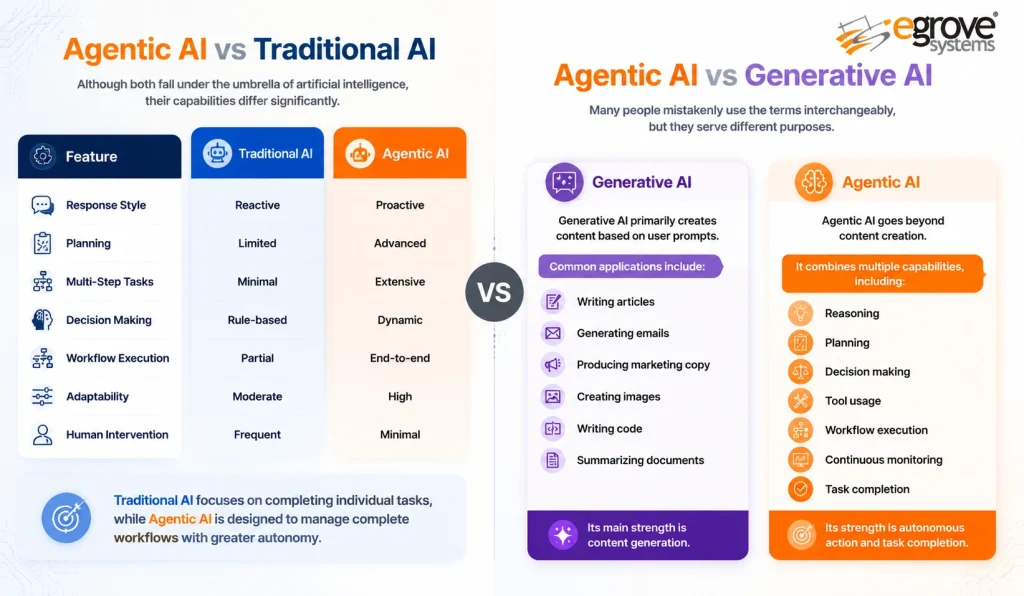
Many people mistakenly use the terms interchangeably, but they serve different purposes.
Generative AI
Generative AI primarily creates content based on user prompts.
Common applications include:
- Writing articles
- Generating emails
- Producing marketing copy
- Creating images
- Writing code
- Summarizing documents
Its main strength is content generation.
Agentic AI
Agentic AI goes beyond content creation.
It combines multiple capabilities, including:
- Reasoning
- Planning
- Decision making
- Tool usage
- Workflow execution
- Continuous monitoring
- Task completion
In many enterprise environments, agentic AI may use generative AI as one component while also orchestrating actions across business systems to accomplish larger objectives.
Why Businesses Are Investing in Agentic AI
Organizations investing in Agentic AI gain advantages that extend beyond basic automation.
Increased Productivity
By handling repetitive, time-consuming tasks autonomously, Agentic AI enables employees to focus on innovation, strategic planning, and customer relationships.
Faster Decision Making
Agentic AI processes information in real time, allowing businesses to make faster and more informed decisions.
Improved Operational Efficiency
Automating multi-step workflows reduces delays, eliminates bottlenecks, and improves collaboration across departments.
Reduced Human Error
By consistently following predefined objectives and business rules, Agentic AI minimizes manual mistakes and improves process reliability.
Better Customer Experiences
Personalized interactions, quicker response times, and proactive support contribute to higher customer satisfaction and stronger brand loyalty.
Scalability
As businesses grow, Agentic AI can manage increasing workloads without requiring proportional increases in staffing, making it a scalable solution for expanding enterprises.
Challenges of Agentic AI Adoption
While the opportunities are significant, implementing Agentic AI requires careful planning.
Data Quality
AI systems rely on accurate, relevant, and well-structured data. Poor-quality data can reduce the effectiveness of autonomous decision-making.
System Integration
Successful Agentic AI implementations often require integration with existing enterprise platforms such as CRM, ERP, HRMS, and cloud-based applications.
Governance and Compliance
Organizations must establish governance policies that ensure AI decisions remain transparent, ethical, and compliant with industry regulations.
Security
Protecting sensitive business information requires robust cybersecurity practices, secure APIs, access controls, and continuous monitoring.
Change Management
Employees should understand how Agentic AI complements their work rather than replacing it. Proper training and communication are essential for successful adoption.
Best Practices for Implementing Agentic AI
Businesses considering Agentic AI should follow a structured implementation strategy.
Identify High-Value Use Cases
Start by selecting business processes that involve repetitive decision-making, high transaction volumes, or complex workflows.
Build on Reliable Data
Ensure that data sources are accurate, consistent, and well-governed before deploying autonomous AI systems.
Integrate with Existing Systems
Connect Agentic AI with enterprise applications to enable seamless workflow automation and real-time data exchange.
Maintain Human Oversight
While agentic AI operates autonomously, human supervision remains important for strategic decisions, compliance, and continuous improvement.
Measure Performance
Track key performance indicators such as productivity, response times, operational costs, customer satisfaction, and process accuracy to evaluate success.
The Future of Agentic AI
Agentic AI represents the next phase of enterprise automation. As technologies continue to evolve, intelligent agents will become increasingly capable of managing complex business operations across multiple systems.
Future advancements are expected to include:
- More sophisticated reasoning capabilities
- Improved collaboration between multiple AI agents
- Stronger enterprise integrations
- Greater personalization
- Enhanced security and governance
- Wider adoption across industries
Organizations that invest early in Agentic AI will be better positioned to improve operational efficiency, accelerate innovation, and remain competitive in an increasingly AI-driven marketplace.
Why Partner with eGrove Systems for Agentic AI Solutions?
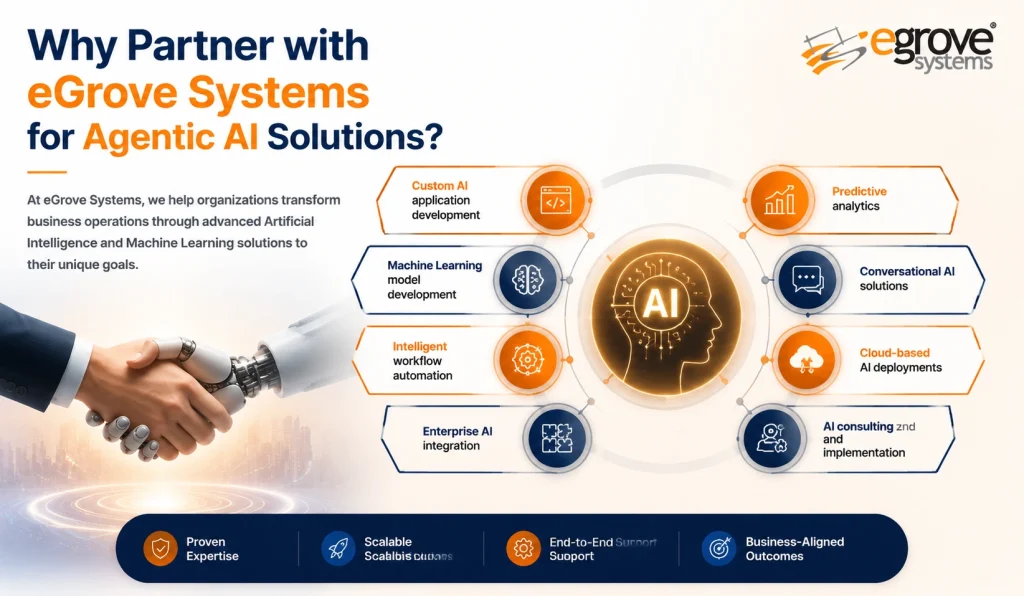
At Tailored eGrove Systems, we help organizations transform business operations through advanced artificial intelligence and machine learning solutions to their unique goals.
Our expertise includes:
- Custom AI application development
- Machine Learning model development
- Intelligent workflow automation
- Enterprise AI integration
- Predictive analytics
- Conversational AI solutions
- Cloud-based AI deployments
- AI consulting and implementation
Whether you’re looking to automate business processes, enhance customer experiences, or develop intelligent enterprise applications, our team delivers scalable AI solutions designed for long-term business success.
Explore our Artificial Intelligence and Machine Learning Services to discover how AI can help accelerate your digital transformation journey.
Conclusion
Agentic AI represents an important development in artificial intelligence by enabling systems to move beyond responding to prompts and toward independently planning, reasoning, and executing complex tasks. Its ability to automate end-to-end workflows, integrate with enterprise systems, and adapt to changing business conditions makes it a powerful technology for organizations seeking greater efficiency and innovation.
As enterprises continue embracing digital transformation, Agentic AI will play an increasingly important role in improving productivity, streamlining operations, and enhancing customer experiences.
Businesses that begin exploring Agentic AI today will be better prepared to build intelligent, autonomous, and future-ready operations. Partnering with an experienced AI development company like eGrove Systems can help ensure a successful implementation that aligns with your business objectives and delivers measurable results.
Did You Know?
AI Evolution
-
Rule-Based AI → Fixed automation
-
ML Systems → Prediction engines
-
Generative AI → Content creation
-
Copilots → Assisted productivity
-
Agentic AI → Fully autonomous execution systems