
Managing employee training is no longer simply about assigning courses and recording completions. Organizations need continuous visibility into compliance, employee progress, certifications, skill development, and workforce readiness. As regulatory requirements shift and workforces grow more distributed, the systems built to manage this, largely unchanged for a decade or more, are struggling to keep up.
Most organizations still manage training through spreadsheets, disconnected systems, manual reminders, and scattered compliance records. As headcount grows, these processes make it difficult for HR, learning and development, and compliance teams to answer basic operational questions: Who has completed mandatory training? Which employees have overdue requirements? Where are compliance gaps developing? Are certifications current? Can the right records be pulled quickly during an audit?
This piece looks at why traditional training infrastructure falls short, what changes when AI is built into the platform rather than bolted on, and what a modern, compliance-first learning environment looks like in practice.
Why Traditional Training and Compliance Management Falls Short
The core problem isn’t a lack of training content. Most organizations have plenty of courses, policies, and modules already built. The problem is a lack of visibility, personalization, and connection between systems.
One-size-fits-all delivery. The same course, at the same length, in the same format, goes to every employee regardless of role, tenure, or prior knowledge. A new hire and a ten-year veteran sit through identical material, which wastes time for one and under-serves the other.
Completion isn’t comprehension. A finished course tells you an employee clicked through the material. It doesn’t tell you whether they retained the specific knowledge that matters when a real compliance situation arises on the job. Static, multiple-choice quizzes at the end of a module are a weak proxy for actual understanding.
Reactive compliance. In most organizations, training gaps surface during an audit, after an incident, or when a regulator asks a pointed question, not early enough to prevent the underlying problem. By the time a gap is visible, it’s often already a liability rather than a fixable process issue.
Disconnected records. Training data typically lives apart from HR systems, performance reviews, and workforce planning tools. Certificates sit in one place, completions in another, and compliance deadlines in a spreadsheet someone updates manually. This fragmentation makes it hard to see the full picture of workforce readiness, let alone act on it quickly.
No forward-looking signal. Traditional LMS platforms are built to record what already happened. They rarely flag who is likely to fall behind, which teams are trending toward a compliance gap, or where a skills shortage is forming before it affects performance.
Together, these gaps mean that training and compliance management often function as a documentation exercise rather than an active risk-reduction and workforce-development tool.
What an AI-Powered Approach Changes
Bringing AI into the core of a training platform, rather than treating it as an add-on feature, changes what the system is capable of doing. Below are the capabilities that matter most, and why each one addresses a specific gap in the traditional model.
Intelligent, Role-Based Training Assignment
Different roles carry different compliance obligations and different development needs. A warehouse employee doesn’t need the same training as someone in finance, and a new hire doesn’t need the same onboarding sequence as someone who has been with the organization for years.
Rather than relying entirely on someone manually assigning courses, an intelligent system can structure learning around employee role, department, compliance responsibility, and onboarding stage. This reduces repetitive administrative work for HR and L&D teams while making sure the right training actually reaches the right people, instead of broad blanket assignments that create noise and disengagement.
AI Training and Workforce Readiness: Key Data
- 59% of workers worldwide will require training by 2030.
- 39% of employees’ existing skills are expected to change or become outdated between 2025 and 2030.
- 63% of employers identify skill gaps as the biggest barrier to business transformation.
- 31% of the workforce may require retraining or reskilling within three years, according to surveyed CEOs.
- 50% of CEOs say rapid technology investment has created disconnected, fragmented systems within their organizations.
What this means: Organizations need connected, AI-powered training platforms that can identify skill gaps, automate compliance tracking, personalize learning, and provide real-time workforce insights.
Centralized Compliance Training Across Categories
Compliance requirements span a wide range of areas: workplace safety, cybersecurity, HR policy, data privacy and HIPAA, anti-harassment and POSH training, onboarding, and other industry-specific regulatory requirements. When each of these lives in a separate system or process, tracking becomes fragmented almost by design.
A centralized approach brings mandatory and role-specific learning into one environment, giving compliance and HR teams a single, consistent method for assigning, monitoring, and documenting training across every category rather than piecing together records from multiple disconnected tools.
AI-Powered Personalization
Employee development is more effective when learning reflects what an individual actually needs, not a generic curriculum applied uniformly. AI-driven recommendation and pathway logic can adjust content based on role, demonstrated progress, and specific knowledge gaps, so that someone who consistently struggles with a topic gets more reinforcement there, while someone who’s already proficient moves through faster.
This shifts AI from a compliance-administration tool into something that also supports continuous upskilling, connecting day-to-day training activity to genuine skill development rather than treating both as the same checkbox exercise.
Automated Notifications and Reminders
Manually reminding employees about upcoming deadlines, overdue requirements, and expiring certifications consumes a disproportionate amount of HR and administrative time, especially as headcount grows. Automated notification workflows handle this consistently, covering upcoming training, outstanding requirements, and certification-related actions without requiring a person to track and send every reminder individually.
The practical effect is that HR teams spend less time chasing completions and more time on higher-value work, like actually improving the training program itself.
Real-Time Compliance Dashboards
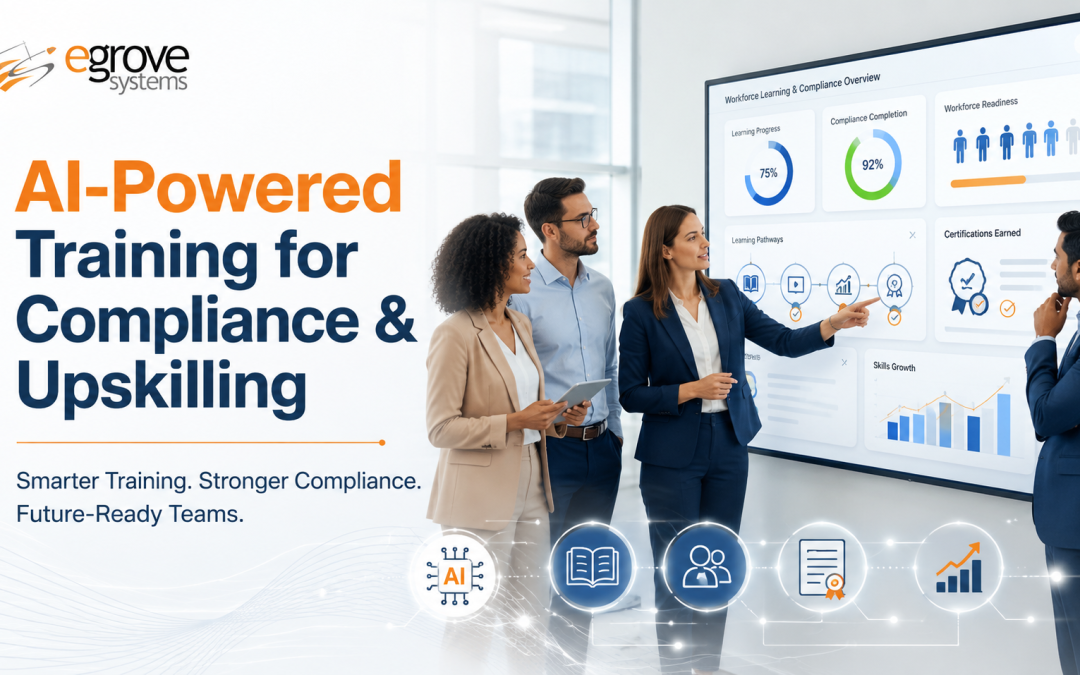
Visibility is the difference between managing compliance proactively and discovering problems after the fact. Real-time dashboards give managers and compliance teams a centralized view of training status, outstanding requirements, and emerging risk areas, replacing the need to search across spreadsheets or ask multiple people for updates.
This kind of visibility makes it possible to catch a developing compliance gap while it’s still a small, fixable issue, rather than something that surfaces for the first time during an audit.
Employee Progress Tracking
Completion data alone doesn’t provide enough information to manage a workforce effectively. Centralized progress tracking gives a fuller picture, covering completed learning, outstanding training, individual progress trends, and certification status, all in one place rather than scattered across records.
This level of visibility supports two things at once: it encourages individual accountability, since progress is visible rather than hidden in a spreadsheet, and it gives managers a clear signal for when to step in with additional support.
Assessments and Learning Evaluation
Assessments matter because they measure something completion tracking can’t: whether an employee is actually building the required knowledge, not just clicking through a course. Intelligent, assessment-focused evaluation gives organizations a way to identify where reinforcement is genuinely needed, rather than assuming a completed module equals comprehension.
This creates a tighter feedback loop between training delivery and actual workforce development, since assessment data can feed directly back into what content an employee sees next.
Certificates and Certification Management
For many industries, certificates and audit-ready reports are the primary evidence that training and compliance obligations have been met. Centralized certificate management gives teams better visibility into employee achievements and outstanding certification requirements, instead of relying on scattered records, individual folders, or manual tracking spreadsheets.
This matters most in the moments when documentation is needed quickly, whether that’s an internal review, a customer audit, or a regulatory request.
Analytics and Reporting
Raw training data only becomes useful once it can be turned into decisions. Analytics and reporting capabilities help organizations identify where employee progress is falling behind, which areas need attention, and what compliance trends are emerging across teams or locations.
This turns training data from a passive record into an input for actual planning, informing where L&D should focus next and where compliance risk is concentrated.
Audit-Ready Reporting
Audit preparation becomes genuinely difficult when training records live across emails, spreadsheets, certificates, and multiple disconnected systems. Centralizing the full compliance lifecycle, from assignment through learning, tracking, automation, and reporting, creates a more structured foundation for audit preparation.
It’s worth being direct here: no platform eliminates compliance risk or guarantees audit outcomes on its own. What centralized, well-documented training activity does is make the information required for compliance management far more visible and far easier to produce on demand.
Mobile Learning
Employees increasingly need to access training outside a traditional desktop environment, particularly in industries with field staff, multi-location operations, or distributed teams. Mobile access lets employees complete required learning alongside their regular responsibilities rather than needing dedicated desktop time, which matters directly for completion rates in these environments.
Role-Based Access
Training and compliance platforms hold information relevant to different organizational responsibilities, and not everyone should see the same data. Role-based access lets administrators, managers, and employees interact with the platform according to what’s actually relevant to their role, keeping sensitive compliance data appropriately scoped.
Multi-Location Workforce Management
Training complexity increases quickly once an organization operates across multiple offices or operational sites. Centralized, multi-location support allows organizations to maintain consistency in training standards and compliance requirements while still accommodating the practical differences between sites, teams, and regions.
System Integration
Training platforms rarely operate in isolation from the rest of an organization’s technology stack. Integration capabilities let a training platform connect with existing HR, performance management, and enterprise systems, reducing fragmented processes and creating a genuinely connected view of workforce data rather than yet another disconnected tool.
Connecting Compliance and Upskilling Into One Workflow
The strongest argument for an AI-powered training platform isn’t any single feature above, it’s what happens when these capabilities work together as one system rather than a collection of separate tools. A useful way to think about this is as a continuous lifecycle:
Assign → Learn → Track → Automate → Report
When these stages are connected, compliance training and skills development stop being two separate initiatives run through different processes. The same infrastructure that keeps a workforce audit-ready also becomes the mechanism for identifying skills gaps and building targeted upskilling programs. Training data that would otherwise sit in a spreadsheet becomes an input for workforce planning, retention strategy, and internal mobility decisions.
The table below summarizes what changes when these stages are connected rather than handled separately.
| Traditional Approach | Connected AI-Powered Approach |
| Manual task assignment | Intelligent, role-based auto-assignment |
| Spreadsheet tracking | Centralized employee progress tracking |
| Manual reminders | Automated notifications |
| Disconnected training systems | Centralized learning management |
| Limited visibility | Real-time compliance dashboards |
| Reactive audit preparation | Structured, audit-ready reporting |
| Generic learning content | AI-powered, personalized learning paths |
| Scattered records | Centralized analytics and reporting |
What to Look for When Evaluating a Platform
Organizations evaluating AI-powered training platforms should look past feature lists and ask a few practical, concrete questions:
- Does the platform personalize content based on real learner data, or does it just segment by job title?
- Can it flag compliance risk proactively, or does it only report on completions after the fact?
- Does it integrate with existing HR and performance systems, or does it operate as a silo?
- How transparent is the platform about how its AI-driven recommendations and risk insights are generated?
- Can assignments, content, and reporting scale across multiple locations and distributed teams without adding manual work?
- Does assessment data actually feed back into what an employee is assigned next, or is it a dead end?
The answers will vary by industry and organization size, but the underlying test stays the same: does the platform actively reduce compliance risk and close skills gaps, or does it just digitize the same static process that wasn’t working before?
Where eGrove Systems Fits
eGrove Systems’ Sevnest is an AI-powered compliance and workforce learning platform built around this shift, centralizing training, tracking, and reporting in one environment instead of spreadsheets and disconnected tools. It supports intelligent role-based assignment, AI-powered personalization, and assessment-based evaluation that measures comprehension rather than just completion. Automated notifications and real-time compliance dashboards reduce manual follow-up and surface gaps early, while certificates, analytics, and audit-ready reporting bring the full lifecycle, assign, learn, track, automate, report, into one connected workflow. Mobile access, role-based permissions, multi-location support, and system integrations let it scale across distributed teams as an organization grows. Sevnest also offers ready-to-deploy compliance courses covering OSHA, HIPAA, cybersecurity, DEI, and workplace harassment prevention, so teams aren’t starting content from scratch.
To see how Sevnest can support your organization’s compliance and upskilling strategy, book a free demo with eGrove Systems.