
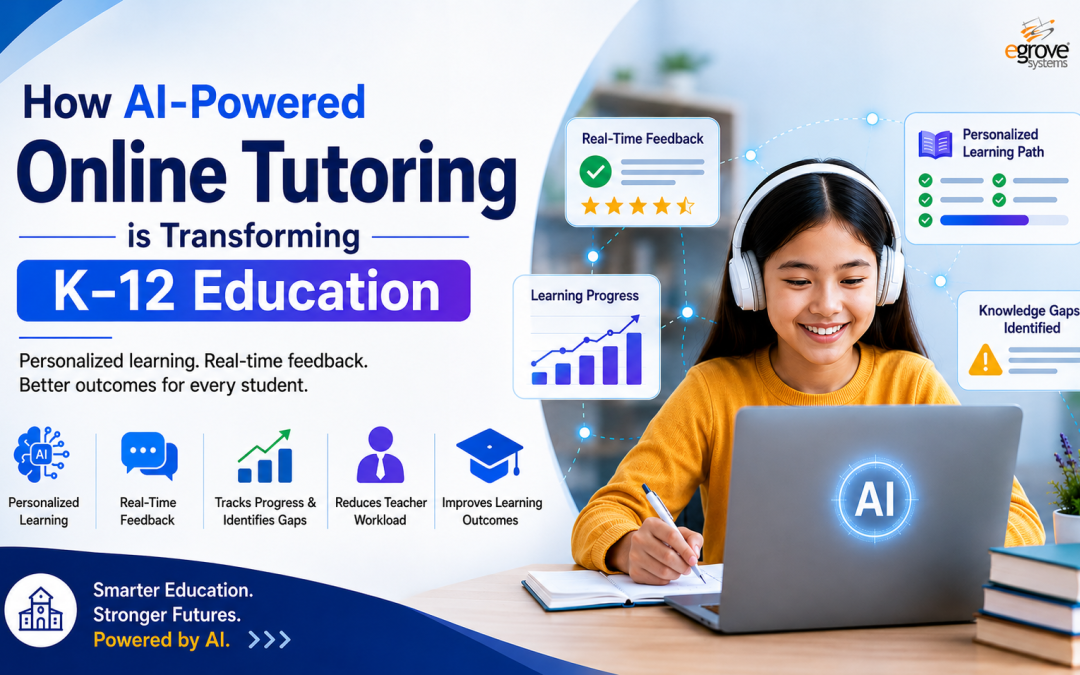
The K–12 education landscape is undergoing one of its biggest transformations in decades. While online learning gained momentum during the pandemic, Artificial Intelligence (AI) is now redefining how students learn, teachers teach, and schools deliver personalized education.
In 2026, AI-powered tutoring platforms have evolved beyond simple chatbots or homework assistants. They now function as intelligent learning companions capable of adapting to every student’s pace, identifying learning gaps, generating customized lesson plans, and providing real time feedback.
For schools, educational institutions, and EdTech providers, AI-powered tutoring is no longer an optional innovation; it has become a strategic necessity for improving learning outcomes while reducing teacher workload. Industry research indicates that AI adoption in education continues to accelerate as institutions increasingly deploy AI teaching assistants, adaptive learning systems, and intelligent assessment tools.
LMS (Learning Management System) is a software platform used to create, deliver, manage, and track online training and learning programs. It helps organizations assign courses, monitor learner progress, conduct assessments, and generate completion reports.
This article explores how AI powered online tutoring is transforming K–12 education and why educational organizations are investing heavily in intelligent learning platforms.
The Evolution of Online Tutoring
Traditional online tutoring primarily relied on scheduled video calls between students and instructors. While effective, this model had several limitations:
- Limited tutor availability
- One-size-fits-all lesson plans
- Lack of continuous assessment
- High operational costs
- Difficulty tracking long-term progress
AI has fundamentally changed this approach. Modern tutoring systems provide personalized instruction 24/7, allowing students to receive immediate assistance whenever they encounter difficulties.
Instead of replacing teachers, AI complements them by handling repetitive educational tasks while allowing educators to focus on critical thinking, mentoring, and classroom engagement.
Why AI Is the Perfect Fit for K–12 Learning
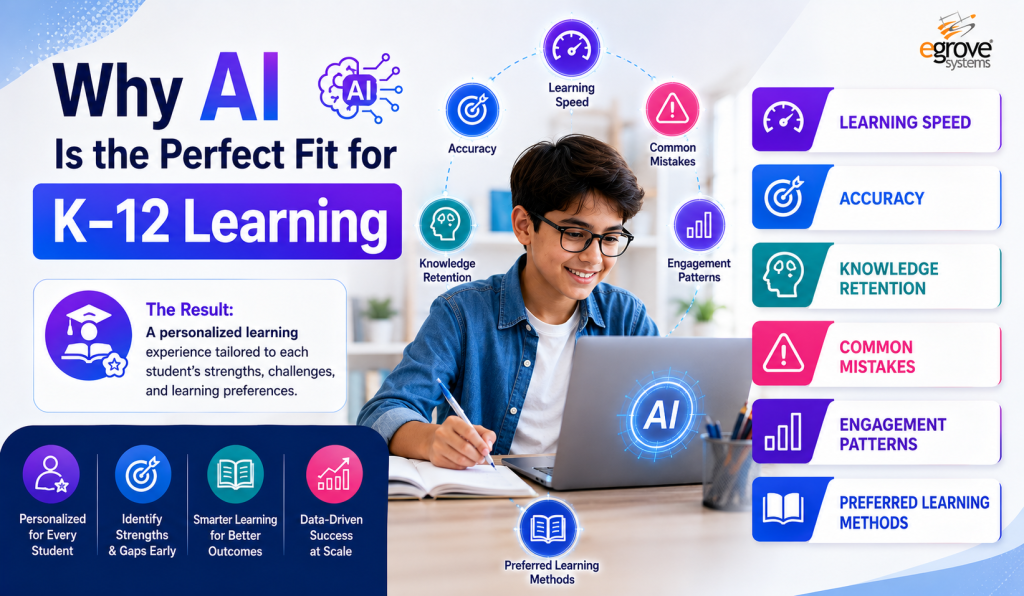
Every student learns differently. Some grasp mathematics quickly but struggle with reading comprehension. Others excel in science while needing additional support in language arts. Traditional classrooms often cannot personalize instruction for every learner due to time constraints.AI solves this challenge by analyzing learning behavior continuously and adapting instruction accordingly.
Modern AI tutoring systems evaluate:
- Learning speed: How quickly each student understands new concepts and progresses through lessons.
- Accuracy: How correctly students answer questions and complete learning activities.
- Knowledge retention: How well students remember and apply previously learned concepts over time.
- Common mistakes: Frequently repeated errors that help identify knowledge gaps and areas needing improvement.
- Engagement patterns: How actively students participate, interact with content, and stay focused during learning.
- Preferred learning methods: The formats and teaching approaches, such as videos, quizzes, or reading, that help each student learn most effectively.
The result: A personalized learning experience tailored to each student’s strengths, challenges, and learning preferences.
Personalized Learning at Scale
One of AI’s greatest strengths is delivering personalized education to thousands of students simultaneously. Instead of assigning identical worksheets to an entire class, AI dynamically adjusts lessons based on individual performance.
For example: If a Grade 5 student consistently struggles with fractions, the AI system automatically:
- Revisits prerequisite concepts
- Generates additional practice questions
- Explains concepts differently
- Uses visual examples
- Reduces lesson difficulty
- Tracks improvement over time
Meanwhile, students who master the topic quickly receive more advanced challenges. This individualized approach keeps learners engaged without overwhelming or under-challenging them. Large-scale education studies have reported measurable improvements in learning outcomes from adaptive AI systems.
Real-Time Feedback Improves Learning
Traditional education often involves delayed feedback. Students may wait days before discovering whether they answered questions correctly.AI tutoring changes this completely.
Students receive:
- Instant corrections: Receive immediate feedback on mistakes with accurate corrections as soon as an answer is submitted.
- Step-by-step explanations: Understand each solution through clear, detailed explanations that break down the problem-solving process.
- Personalized hints: Get tailored hints based on your performance to help you solve problems independently without revealing the full answer.
- Alternative solution methods: Explore different approaches to solving the same problem, helping you build deeper understanding and flexibility.
- Practice recommendations: Receive customized practice suggestions based on your strengths and areas for improvement to reinforce learning.
Immediate feedback prevents misconceptions from becoming long term learning gaps. It also improves confidence since students understand mistakes while concepts remain fresh.
AI Identifies Learning Gaps Before Teachers Notice
Modern AI tutoring platforms continuously analyze student performance. Rather than waiting until report cards reveal poor performance, AI detects warning signs much earlier.
Examples include:
- Declining quiz scores: Students are scoring lower on assessments over time, indicating reduced knowledge retention and potential learning gaps.
- Reduced engagement: Students are participating less in training activities, showing lower interest, interaction, or motivation to learn.
- Longer response times: Students are taking more time than usual to complete training modules, quizzes, or assigned learning tasks.
- Repeated mistakes: Students continue making the same errors despite completing training, suggesting that key concepts are not being effectively understood or applied.
- Missed assignments: Students are failing to complete mandatory learning activities or training tasks within the required deadlines.
- Inconsistent attendance: Students are irregularly attending scheduled training sessions, leading to gaps in learning and compliance readiness.
Predictive analytics help teachers intervene before students fall significantly behind. This proactive approach improves academic success while reducing dropout risks.
Supporting Teachers Instead of Replacing Them
A common misconception is that AI will replace educators. In reality, AI serves as a teaching assistant rather than a substitute.
Teachers remain essential for
- Emotional support: Building trust, understanding students’ emotions, motivating learners, and providing encouragement that technology cannot replicate.
- Classroom discussions: Leading meaningful conversations, encouraging collaboration, and adapting discussions based on students’ responses.
- Critical thinking: Challenging students to analyze, question, evaluate, and solve complex real-world problems through guided learning.
- Creativity: Inspiring imagination, innovation, and original thinking through hands-on activities, projects, and personalized feedback.
- Social development: Helping students develop communication skills, teamwork, empathy, respect, and positive interpersonal relationships.
- Ethical guidance: Teaching values, responsible decision-making, digital citizenship, and appropriate behavior both inside and outside the classroom.
AI automates repetitive tasks such as
- Homework grading: Automatically evaluating assignments and providing instant feedback, reducing manual grading time.
- Lesson planning assistance: Recommending lesson structures, learning resources, and classroom activities aligned with curriculum objectives.
- Progress tracking: Monitoring student performance over time and highlighting learning trends or areas requiring additional support.
- Quiz generation: Creating customized quizzes and assessments based on learning objectives and student proficiency levels.
- Attendance insights: Identifying attendance patterns, irregularities, and students who may need timely intervention.
- Learning analytics: Analyzing student performance data to generate actionable insights that support personalized instruction.
This allows teachers to spend more time interacting directly with students. Surveys continue to show that educators see the greatest value when AI reduces administrative workload rather than replacing human instruction.
Making Learning Available 24/7
Students rarely encounter learning challenges only during school hours. Homework, revision, and exam preparation often happen in the evenings or weekends.AI tutors provide continuous learning support.
Students can ask questions at any time and receive:
- Explanations: Clear, step-by-step explanations that simplify difficult concepts and improve understanding.
- Practice exercises: Personalized practice questions that reinforce learning and strengthen subject knowledge.
- Revision notes: Concise summaries of key topics that make exam preparation faster and more effective.
- Examples: Real-world and subject-specific examples that help students connect theory with practical applications.
- Interactive quizzes: Instant-feedback quizzes that assess understanding and identify areas requiring further improvement.
This accessibility is particularly valuable for students without access to private tutoring.
Adaptive Assessments Create Better Outcomes
Traditional exams provide a snapshot of learning.AI assessments continuously measure student understanding throughout the learning journey.
Instead of fixed tests, adaptive assessments:
- Adjust question difficulty: AI automatically increases or decreases the difficulty of questions based on each student’s responses, creating an appropriate level of challenge.
- Focus on weak topics: The system identifies areas where students struggle and provides more targeted questions and practice to strengthen those concepts.
- Recommend additional learning: Based on assessment performance, AI suggests personalized lessons, videos, exercises, and resources to help students improve.
- Monitor long-term progress: AI tracks learning trends over time, allowing educators to see continuous improvement rather than relying on one-time test scores.
- Generate personalized reports: Detailed reports provide students, teachers, and parents with individualized insights, highlighting achievements, strengths, and areas that need attention.
Teachers gain deeper insights into student development. Parents also receive meaningful progress updates rather than simple grades.
Better Engagement Through Interactive Learning
Today’s students are digital natives. Static textbooks no longer provide sufficient engagement.
AI-powered tutoring platforms integrate:
- Gamification: Uses points, badges, rewards, challenges, and leaderboards to make learning enjoyable, motivating, and engaging.
- Interactive simulations: Allows students to practice real-world concepts through hands-on virtual experiments and scenario-based learning activities.
- Educational videos: Delivers complex topics through engaging visual content, animations, and demonstrations that improve understanding and retention.
- Voice conversations: Enables natural, AI-powered spoken interactions that help students ask questions, practice communication, and receive instant feedback.
- Visual explanations: Simplifies difficult concepts using diagrams, charts, illustrations, and animations to enhance comprehension and memory.
- Adaptive storytelling: Personalizes learning through interactive stories that adjust to each student’s interests, pace, and learning progress.
Interactive learning significantly increases student motivation while improving knowledge retention.
Supporting Students with Different Learning Needs
AI also improves educational accessibility. Students with different abilities benefit from features such as:
- Speech-to-text: Converts spoken words into written text, helping students who have difficulty typing, writing, or hearing lectures.
- Text-to-speech: Reads digital content aloud, supporting students with visual impairments, dyslexia, or reading difficulties.
- Live translation: Instantly translates lessons and classroom discussions into multiple languages, making learning more accessible for multilingual students.
- Reading assistance: Simplifies complex text, explains difficult vocabulary, and provides guided reading support to improve comprehension.
- Personalized pacing: Adapts the speed and difficulty of learning materials based on each student’s individual progress and learning style.
- Accessibility enhancements: Offers features such as captions, screen reader compatibility, adjustable fonts, high-contrast displays, and alternative input methods to support diverse learning needs.
Inclusive learning environments become easier to build using intelligent educational technologies.
Parent Involvement Becomes More Meaningful
Parents often struggle to understand how their children are progressing academically.AI platforms simplify communication through detailed dashboards showing:
- Daily learning activity: Provides a clear overview of lessons completed, time spent learning, and daily participation in educational activities.
- Subject-wise performance: Displays progress and achievement in each subject, helping parents identify areas where their child excels or needs additional support.
- Homework completion: Tracks assigned, completed, and pending homework, ensuring parents stay informed about their child’s responsibilities.
- Learning strengths: Highlights subjects, skills, and concepts where the student consistently performs well and demonstrates confidence.
- Areas needing improvement: Identifies learning gaps, challenging topics, and concepts requiring extra practice or teacher intervention.
- Weekly progress summaries: Generates easy-to-understand reports summarizing achievements, challenges, attendance, and overall academic growth throughout the week.
This enables more productive conversations between parents, teachers, and students.
Data-Driven Decision Making for Schools
School administrators need accurate insights to improve academic performance.AI tutoring systems generate dashboards covering:
- Student performance trends: Track individual and class performance over time to identify strengths, learning gaps, and areas that require additional support.
- Curriculum effectiveness: Evaluate how well lessons, teaching materials, and curriculum objectives improve student learning outcomes and engagement.
- Teacher workload: Monitor teaching responsibilities, grading tasks, and administrative activities to help balance workloads and improve productivity.
- Attendance patterns: Analyze student attendance records to identify absenteeism trends, detect at-risk learners, and support timely interventions.
- Intervention success rates: Measure the effectiveness of remedial programs, personalized learning plans, and academic support initiatives in improving student outcomes.
- School-wide learning analytics: Provide comprehensive insights into overall academic performance, engagement levels, assessment results, and institutional progress to support informed decision-making.
Educational leaders can use this data to improve resource allocation and academic planning.
AI Helps Bridge Educational Gaps
One of AI’s biggest contributions is expanding access to quality education.Students in rural or underserved areas often lack access to experienced tutors.
AI-powered platforms provide:
- Personalized instruction: AI adapts lessons, explanations, and learning pace to match each student’s individual strengths, weaknesses, and learning style.
- Quality educational resources: Students gain access to reliable, up-to-date learning materials, interactive lessons, videos, and practice content anytime.
- Adaptive practice: AI continuously adjusts the difficulty of quizzes and exercises based on student performance to strengthen understanding and retention.
- Continuous support: AI offers 24/7 assistance by answering questions, providing instant feedback, and guiding students whenever they need help.
Although AI cannot replace experienced educators, it helps make quality learning more accessible at scale.
Challenges Schools Must Address
Despite its advantages, responsible AI adoption requires thoughtful planning. Schools should prioritize:
- Student data privacy: Protect student information by using secure AI systems that comply with privacy regulations and safeguard personal data.
- Ethical AI usage: Ensure AI is used fairly, responsibly, and in ways that support learning without compromising academic integrity.
- Human oversight: Keep teachers actively involved in reviewing AI-generated content and making final educational decisions.
- Bias monitoring: Regularly evaluate AI systems to identify and reduce bias, ensuring fair and inclusive learning experiences for all students.
- Teacher training: Equip educators with the knowledge and skills needed to effectively integrate AI tools into teaching and classroom management.
- Transparent AI policies: Establish clear guidelines that explain how AI is used, ensuring accountability, trust, and responsible implementation across the school.
Successful implementation requires balancing technological innovation with responsible educational practices. Governments and education systems worldwide are increasingly introducing AI policies and guidance to ensure safe adoption in K–12 education.
The Future of AI-Powered K–12 Education
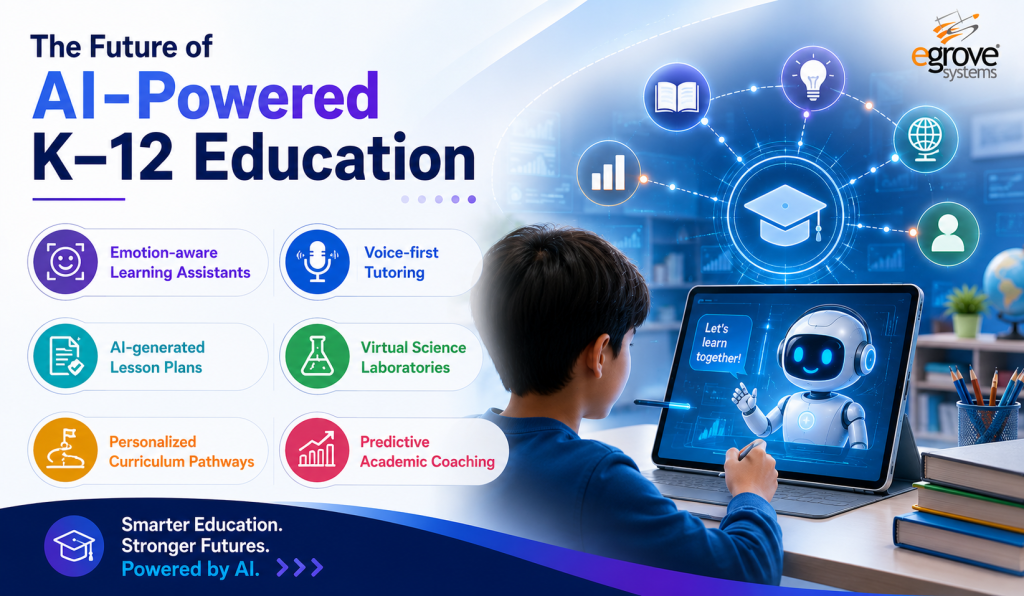
Looking ahead, AI tutoring will become even more intelligent. Emerging capabilities include:
- Emotion-aware learning assistants: AI will recognize students’ emotions and engagement levels, adapting lessons to provide encouragement and personalized support when needed.
- Voice-first tutoring: Students will interact naturally with AI through voice conversations, making learning more accessible, engaging, and hands-free across different devices.
- AI-generated lesson plans: AI will help teachers create customized lesson plans, worksheets, quizzes, and learning materials based on curriculum standards and student performance.
- Virtual science laboratories: Students will safely perform interactive virtual experiments, explore scientific concepts, and gain practical experience without the need for physical lab equipment.
- Personalized curriculum pathways: AI will create individualized learning journeys by adjusting content, pace, and difficulty according to each student’s strengths, weaknesses, and learning goals.
- Predictive academic coaching: AI will analyze learning patterns to identify students who may need additional support and recommend timely interventions before academic challenges become serious.
Rather than replacing schools, AI will make education more personalized, inclusive, and data-driven.The schools that adopt AI responsibly today will be better equipped to prepare students for tomorrow’s digital economy.
How eGrove Systems Helps Build AI-Powered Education Solutions
As AI reshapes K–12 education, educational institutions need secure, scalable, and user-centric digital platforms that enhance both teaching and learning. At eGrove Systems, we help EdTech companies, schools and educational organizations build next-generation AI-powered learning solutions tailored to modern education needs.
Our expertise includes:
- AI-powered education platform development
- Custom Learning Management Systems (LMS)
- Intelligent tutoring and chatbot integration
- Cloud-native application development
- Mobile learning applications
- Data analytics and reporting dashboards
- Secure, scalable web application development
- UX/UI design for educational platforms
- API integrations with third-party educational tools
- Ongoing maintenance and support
Let’s Build Smarter Learning Together
The future of education is intelligent, personalized, and data driven. Let eGrove Systems help you bring your vision to life with innovative AI-powered education technology.
Request a consultation today
Information Box:
AI in K–12 Education : 2026 Trends & Statistics
| Trend | 2026 Insight |
|---|---|
| AI in Education Market | The global AI in education market is projected to reach approximately $12.3 billion in 2026. |
| Institutional Adoption | 83% of educational institutions plan to deploy AI teaching assistants by the end of 2026. |
| Personalized Learning | Adaptive AI learning systems have demonstrated up to 42% improvement in learning outcomes in large-scale implementations. |
| Teacher Productivity | Around 67% of educators report AI saves more than 10 hours per week on content creation and administrative tasks. |
| Responsible AI | 71% of educators identify data privacy and algorithmic bias as top concerns for AI adoption in education. |
| Teacher Guidance Gap | Approximately 80% of teachers report receiving little or no formal guidance on implementing AI effectively in classrooms. |
| K–12 AI Policies | Governments and school systems worldwide are introducing structured AI policies, AI literacy programs, and curriculum updates for K–12 education. |