
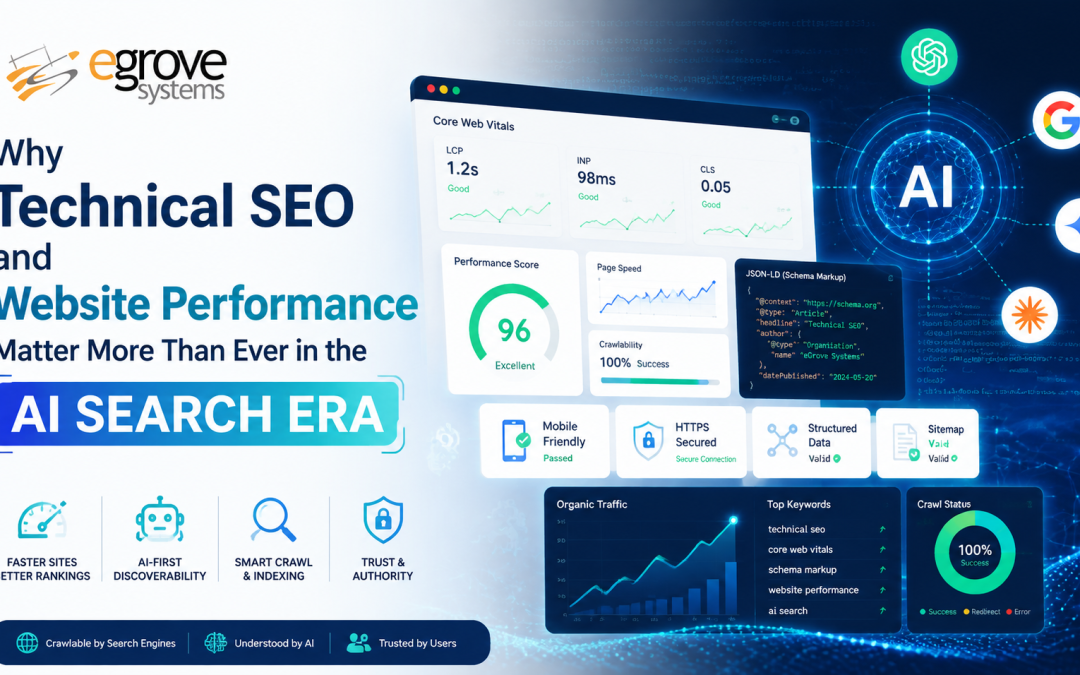
The search used to end with a list of blue links. Today, it increasingly ends with a conversational answer from ChatGPT, Google AI Overviews, Gemini, Claude, or Perplexity, and a user never has to click through to a website to get it. That single shift is rewriting the rules of online visibility, and it’s making the technical foundation of a website more important than ever, not less.
These AI systems don’t just read your content. Before they’ll summarize or cite it, they evaluate whether your site can be crawled efficiently, loads quickly, and is structured in a way a machine can parse with confidence. Technical SEO has quietly become the gatekeeper that decides whether strong content ever gets the chance to compete for an AI-generated answer in the first place.
What Technical SEO Actually Covers
Technical SEO is the practice of optimizing a website’s infrastructure so that search engines and AI systems can crawl, understand, and index it efficiently. Unlike traditional SEO, which leans heavily on keywords and content, technical SEO operates behind the scenes across areas like:
- Page speed and Core Web Vitals
- Crawlability and indexability
- Schema markup and structured data
- Mobile responsiveness
- XML sitemaps and robots.txt configuration
- HTTPS security
- Internal linking architecture
- Accessibility (WCAG compliance)
Get these fundamentals wrong, and even the best-written content can go unseen by both traditional search engines and the AI systems now standing between a business and its audience.
The Search Engine Is Now a Retrieval System
Most AI-generated answers are powered by retrieval-augmented generation (RAG): the system searches the live web, pulls relevant pages, and synthesizes an answer from what it finds. That means the underlying mechanics of search haven’t been replaced so much as re-weighted. The same pages that used to rank are still the ones being pulled into AI answers; they’re just being selected and packaged differently.
The traffic impact is already measurable. Industry research on AI Overviews has found that when Google surfaces an AI-generated summary, click-through to the top organic result can drop by roughly a third compared to a traditional results page. Fewer clicks per query means every remaining click, and every AI citation, has to work harder. Sites can no longer count on ranking position alone to drive traffic; they need to earn a spot inside the answer itself.
Why the Technical Layer Carries More Weight Now
AI search favors technically healthy websites: Broken pages, duplicate URLs, crawl errors, missing metadata, and weak internal linking all make it harder for AI systems to interpret a site correctly. When that happens, the safer, more reliable outcome for the AI model is simply to skip the page in favor of a competitor’s.
Website speed and Core Web Vitals shape whether content gets a fair look: Largest Contentful Paint (how quickly main content loads), Interaction to Next Paint (how responsive a page feels), and Cumulative Layout Shift (how visually stable a page stays while loading) remain some of the clearest, most measurable signals of site quality. Slow, unstable pages produce higher bounce rates and lower crawl efficiency, which quietly erodes both traditional rankings and AI visibility over time.
Structured data gives AI systems explicit signals about meaning: Schema markup for articles, products, FAQs, organizations, services, and reviews tells an AI system exactly what a page is about and who published it, rather than leaving it to infer that from unstructured text. This is one of the clearest ways to improve the odds of appearing in AI summaries, rich snippets, and knowledge panels, and it remains one of the most underused levers available to marketing teams.
Entity SEO is becoming the connective tissue of AI visibility: Where keyword SEO targets the words someone types, entity SEO optimizes for the concepts behind them: a brand, its products, its authors, and how they all relate. AI systems lean on entity understanding because it removes ambiguity; a page that clearly declares what it’s about gets extracted and cited with far more confidence than one an algorithm has to guess at. Practical entity SEO work includes:
- Person and Organization schema tied to real author bylines and verified company profiles
- Consistent business naming and facts across the website, schema, directories, and social profiles
- Internal linking that maps relationships between related products, services, and topics
- Accurate presence in the Knowledge Graph and reputable third-party sources such as Wikidata
Accessibility improvements double as AI readiness signals: Proper heading structure, descriptive image alt text, sufficient color contrast, keyboard navigation, and ARIA labels weren’t built with AI in mind, but they produce exactly the kind of clean, well-structured markup that both assistive technology and AI crawlers rely on to interpret a page correctly.
Strong content still needs a strong technical foundation: Thin pages, missing metadata, duplicate titles, poor heading hierarchy, and broken canonical tags can bury genuinely good writing. Content and technical SEO aren’t competing priorities; one simply can’t perform without the other.
Authority signals still matter: AI platforms lean toward citing sources that already read as trustworthy, which means quality backlinks, consistent brand mentions, and a reliably healthy site continue to carry weight even as the mechanics of search change around them.
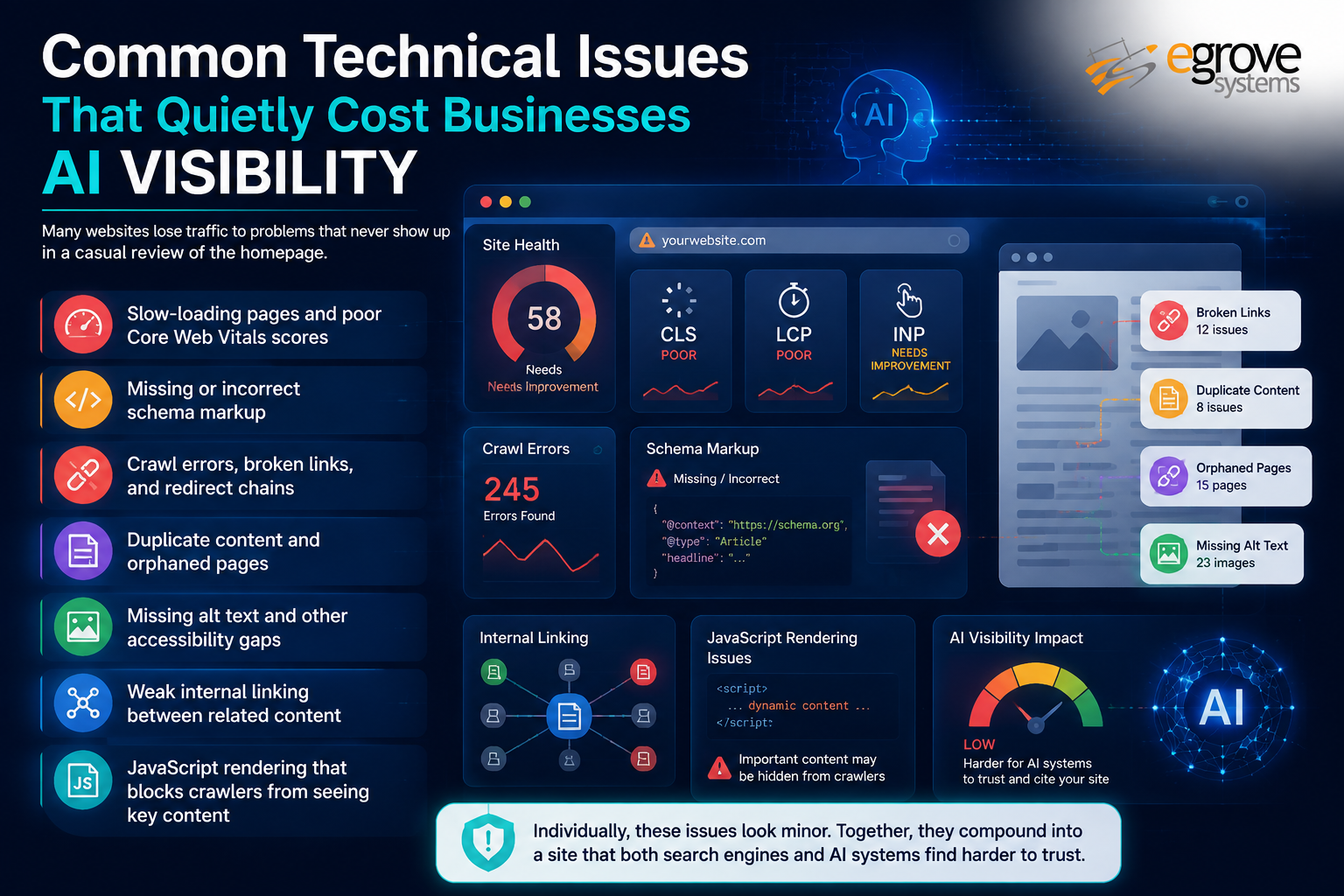
Common Technical Issues That Quietly Cost Businesses AI Visibility
Many websites lose traffic to problems that never show up in a casual review of the homepage:
- Slow-loading pages and poor Core Web Vitals scores
- Missing or incorrect schema markup
- Crawl errors, broken links, and redirect chains
- Duplicate content and orphaned pages
- Missing alt text and other accessibility gaps
- Weak internal linking between related content
- JavaScript rendering that blocks crawlers from seeing key content
Individually, these issues look minor. Together, they compound into a site that both search engines and AI systems find harder to trust.
The Business Case for Getting This Right
Technical SEO investment shows up in outcomes that matter beyond rankings: faster sites, better crawl efficiency, higher engagement, stronger conversion rates, improved accessibility compliance, and greater brand credibility across both traditional search and AI-generated answers. As AI search becomes a larger share of how people find information, a technically sound website becomes a durable competitive advantage rather than a one-time project.
Web accessibility is becoming essential for compliance, SEO, and user experience. Current trends prioritize WCAG 2.2, mobile accessibility, keyboard navigation, accessible authentication, AI-assisted testing, and continuous monitoring. Businesses combining automated audits with expert manual testing can reduce risks, improve search visibility, and serve every user effectively.
Where a Platform Like Elite Site Optimizer Fits In
Auditing all of this manually, across speed, schema, crawlability, accessibility, content quality, and backlinks, is a lot to track with separate tools. This is the gap platforms like Elite Site Optimizer (ESO) are built to close, consolidating technical SEO, performance, and AI-readiness monitoring into a single dashboard. Core capabilities worth knowing about include:
- AI Readiness Audit – measures a site’s readiness for AI-driven search by identifying the technical deficiencies most likely to impact AI discoverability
- Technical SEO Analysis – finds crawl mistakes, indexing problems, sitemap problems and ranks repairs by impact
- Website Performance Monitoring – Monitor LCP, INP & CLS all in one spot to catch performance issues before they hurt rankings
- Schema Validation – find missing or wrong structured data and offer fixes
- WCAG Accessibility Compliance Checks – highlights accessibility concerns that impact usability, compliance, and machine interpretation
- Content Quality Analysis – evaluations on site aspects such metadata, heading hierarchy and canonical tags
- Backlink and Brand Mention Monitoring – measures the authority signals AI tools use to determine what to cite
Tools like these don’t replace the strategic effort of good content and entity development, but they make the technical half of the problem much easier to stay on top of.
Practical Steps to Take Now
- Audit Core Web Vitals across mobile and desktop, and fix the load speed or layout stability issues most likely to be filtering pages out of consideration.
- Confirm schema coverage is accurate and current for Organization, Article, Product, and FAQ content.
- Clean up crawl and indexation gaps, including broken links, redirect chains, and orphaned pages.
- Build out entity SEO deliberately, aligning business facts across the site, schema, and directories, and using internal linking to connect related products, services, and topics.
- Close accessibility gaps, since clean, well-structured markup benefits users and AI crawlers alike.
- Pair every technical fix with genuine expertise. Fast, well-tagged, accessible pages still need original, well-researched content behind them to earn citations rather than just impressions.
Ready to See Where Your Site Stands?
The fastest way to know whether your website is ready for AI-driven search is to audit it. Start a Free AI Readiness Audit with Elite Site Optimizer to get a clear, prioritized view of your Core Web Vitals, schema coverage, crawlability, and accessibility, so you know exactly what to fix first.
Conclusion
Web accessibility is more than a compliance requirement,it improves usability, strengthens SEO, expands audience reach, and creates a better digital experience for everyone. By aligning your website with ADA, WCAG, and Section 508 standards, you can reduce compliance risks while improving search visibility and user engagement.
As an experienced SEO and web accessibility service provider, eGrove Systems helps businesses identify accessibility barriers, resolve technical issues, optimize website performance, and maintain long-term compliance. Partner with eGrove Systems to build a website that is accessible, search-friendly, inclusive, and ready for sustainable growth.