

For over a decade, DevOps has been the gold standard for accelerating software delivery. Organizations embraced continuous integration, continuous deployment (CI/CD), infrastructure automation, and collaboration between development and operations teams to release software faster and more reliably.
However, software ecosystems have grown far more complex than they were when DevOps first emerged. Organizations now manage hundreds of microservices, multiple cloud providers, Kubernetes clusters, Infrastructure as Code (IaC), security policies, compliance requirements, AI workloads, and distributed engineering teams.
This complexity has given rise to a new discipline, platform engineering.
Many technology leaders now say, “Platform engineering is eating DevOps.” This doesn’t mean DevOps is disappearing. Instead, platform engineering builds upon DevOps principles while making them easier to consume through self-service platforms that dramatically improve developer productivity.
For organizations pursuing digital transformation, cloud modernization, AI adoption, and enterprise software development, platform engineering is quickly becoming the next evolution of software delivery.
What Is Platform Engineering?
Platform engineering is the practice of building and maintaining Internal Developer Platforms (IDPs) that provide developers with standardized, self-service tools, workflows, infrastructure, and deployment pipelines.
Instead of every development team configuring cloud resources, CI/CD pipelines, Kubernetes clusters, monitoring tools, security policies, and deployment strategies independently, Platform Engineering centralizes these capabilities into reusable services.
Developers simply request what they need through self-service portals while the platform handles provisioning, governance, security, and automation behind the scenes.
DevOps vs Platform Engineering
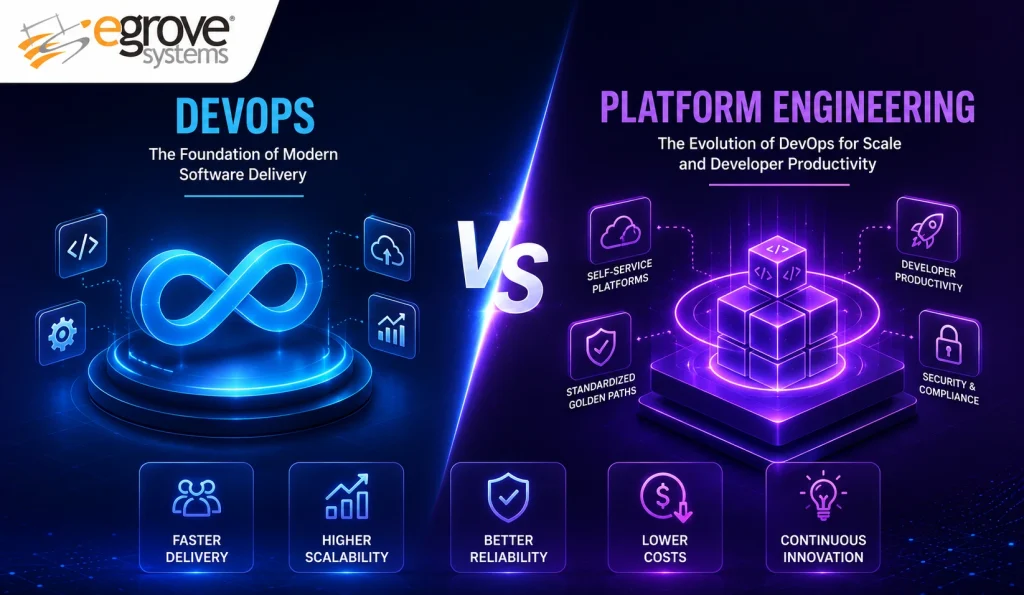
DevOps introduced a culture focused on collaboration between development and operations teams. It encouraged automation, faster deployments, continuous feedback, and shared ownership.
Platform Engineering extends these ideas by treating the internal platform as a product.
| DevOps | Platform Engineering |
| Focuses on collaboration | Focuses on developer experience |
| Teams build their own pipelines | Shared reusable platforms |
| Individual automation | Organization-wide automation |
| Infrastructure managed by each team | Self-service infrastructure |
| Manual configuration across teams | Standardized golden paths |
| Different tooling across projects | Unified engineering platform |
Rather than replacing DevOps, platform engineering operationalizes DevOps best practices at scale.
Why Platform Engineering Is Growing So Fast
Modern engineering organizations face several common challenges:
- Tool sprawl across departments
- Complex Kubernetes management
- Multi-cloud deployments
- Security compliance requirements
- Increasing AI infrastructure needs
- Developer onboarding delays
- Operational bottlenecks
As organizations scale, developers spend significant time configuring environments instead of writing business logic.
Platform Engineering eliminates these repetitive tasks by providing standardized environments that developers can access instantly.
This shift allows engineering teams to focus on innovation rather than infrastructure management.
Internal Developer Platforms (IDPs): The Heart of Platform Engineering
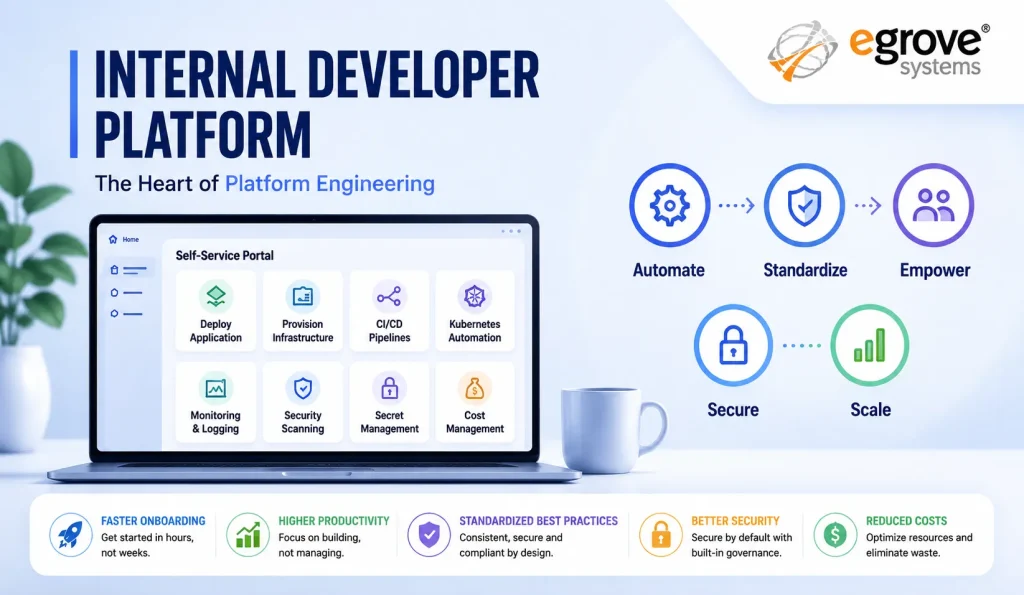
An Internal Developer Platform acts as a centralized engineering hub.
It typically provides the following:
- One-click application deployment
- Infrastructure provisioning
- CI/CD pipelines
- Kubernetes automation
- Secret management
- Identity and access management
- Monitoring dashboards
- Logging
- Security scanning
- Cost management
- Environment creation
Developers interact with a simple interface while the platform automates everything behind the scenes.
This dramatically reduces operational overhead while improving consistency across projects.
The Benefits of Platform Engineering
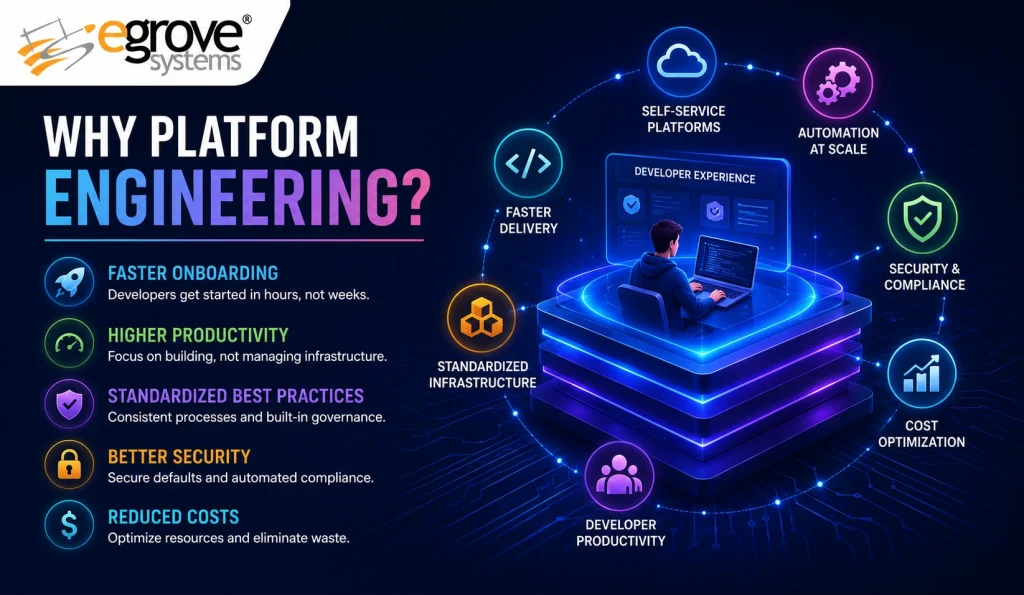
1. Faster Developer Onboarding
New engineers no longer spend days configuring development environments.
With standardized templates and automated provisioning, they can begin contributing within hours instead of weeks.
2. Increased Developer Productivity
Developers spend more time building products instead of:
- Creating infrastructure
- Managing Kubernetes
- Configuring networking
- Setting up monitoring
- Writing deployment scripts
Platform Engineering removes repetitive operational work.
3. Standardized Best Practices
Every application follows the same deployment process.
Security policies, compliance controls, infrastructure standards, and monitoring are built directly into the platform.
This minimizes human error while improving software quality.
4. Better Security
Security becomes part of the platform rather than an afterthought.
Organizations can automatically enforce the following:
- IAM policies
- Encryption
- Vulnerability scanning
- Secret management
- Compliance rules
- Infrastructure policies
Developers inherit secure defaults automatically.
5. Reduced Operational Costs
Standardized infrastructure improves cloud resource utilization.
Platform Engineering helps reduce:
- Duplicate tooling
- Infrastructure waste
- Manual operations
- Deployment failures
- Maintenance costs
The result is greater operational efficiency and improved cloud cost optimization.
Platform Engineering and Cloud Native Development
Cloud-native applications depend heavily on technologies such as:
- Kubernetes
- Containers
- Docker
- Service Mesh
- Terraform
- GitOps
- Infrastructure as Code
- Serverless Computing
Managing these technologies individually becomes increasingly difficult as organizations grow.
Platform Engineering abstracts this complexity into reusable services while maintaining flexibility for engineering teams.
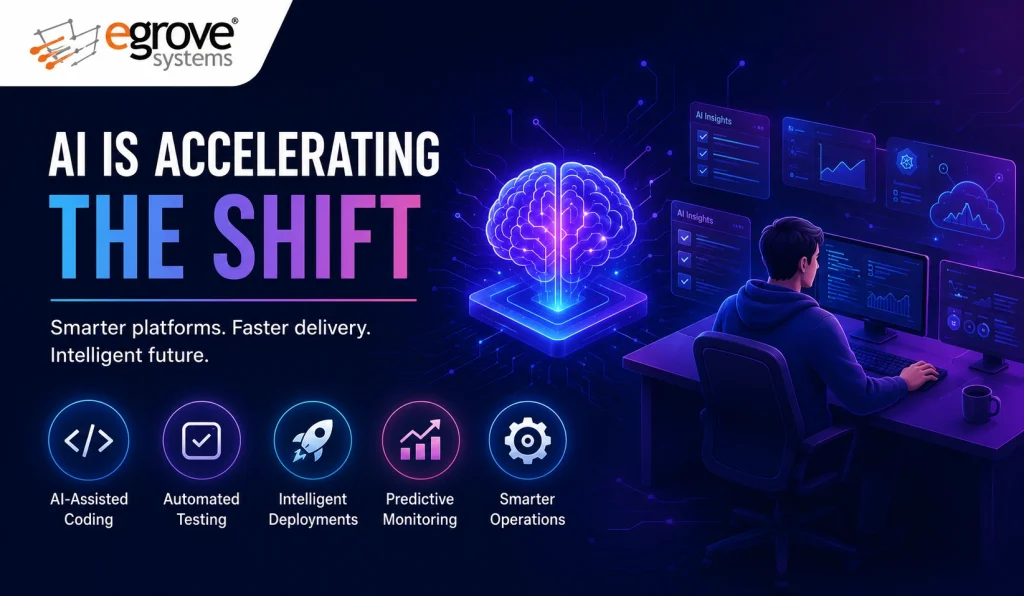
AI Is Accelerating the Shift
Artificial intelligence is reshaping software engineering.
AI-assisted coding, automated testing, intelligent deployment recommendations, predictive monitoring, and infrastructure optimization all require standardized engineering environments.
Platform Engineering provides the foundation that enables AI-driven software delivery by offering consistent infrastructure, centralized workflows, and reusable automation.
Organizations investing in AI increasingly recognize that fragmented DevOps pipelines limit the effectiveness of intelligent automation.
Platform Engineering Improves Developer Experience
Developer Experience (DevEx) has become a key business metric.
Engineering leaders now measure:
- Time to first deployment
- Lead time for changes
- Deployment frequency
- Developer satisfaction
- Platform adoption
- Mean Time to Recovery (MTTR)
Platform Engineering improves these metrics by removing friction throughout the software delivery lifecycle.
Happy developers build better software faster.
Common Platform Engineering Technologies
Modern platform engineering stacks often include:
- Kubernetes
- Docker
- Terraform
- Jenkins
- GitHub Actions
- ArgoCD
- Backstage
- Helm
- Prometheus
- Grafana
- AWS
- Azure
- Google Cloud
- HashiCorp Vault
These technologies work together to provide scalable, secure, and automated development environments.
Challenges Organizations Should Prepare For
Although Platform Engineering offers significant advantages, implementation requires careful planning.
Common challenges include:
- Cultural change
- Platform governance
- Initial investment
- Platform adoption
- Skill development
- Balancing flexibility with standardization
Organizations should avoid creating platforms that become overly complex or difficult for developers to use.
The best platforms simplify engineering rather than adding additional layers of abstraction.
The Future of DevOps
DevOps is not disappearing.
Instead, DevOps is evolving.
Platform Engineering allows DevOps teams to shift from supporting individual applications toward building organization-wide engineering capabilities.
Rather than managing deployments manually, DevOps engineers become platform builders who enable hundreds of developers simultaneously.
This shift creates a multiplier effect across the entire engineering organization.
How eGrove Systems Helps Organizations Adopt Platform Engineering
As enterprises modernize their software delivery processes, they require experienced technology partners who understand cloud-native architectures, DevOps automation, AI integration, and scalable enterprise applications.
eGrove Systems helps organizations build secure, scalable, and future ready software ecosystems through:
- Cloud Engineering and Infrastructure Modernization
- DevOps implementation and CI/CD automation
- Enterprise Application Development
- AI & Machine Learning integration
- Cloud migration and database modernization
- Kubernetes-based application deployment
- Security and compliance implementation
- Performance optimization and cloud cost management
As an AWS Partner, eGrove Systems combines cloud expertise with DevOps practices to help businesses build scalable, secure, and automated software delivery environments tailored to modern enterprise needs.
Whether you’re modernizing legacy systems, implementing cloud-native applications, or preparing for AI-driven software development, eGrove Systems provides end-to-end consulting, engineering, and implementation services that accelerate digital transformation while reducing operational complexity.
Conclusion
Platform Engineering represents the natural evolution of DevOps.
As software ecosystems continue to grow in complexity, organizations need more than automated pipelines; they need standardized platforms that empower developers through self-service capabilities, built-in security, and reusable engineering practices.
Companies adopting platform engineering are seeing faster software delivery, improved developer productivity, stronger governance, reduced cloud costs, and greater readiness for AI-powered development.
For organizations planning their next phase of digital transformation, the question is no longer whether DevOps is enough. The question is how quickly they can evolve toward platform engineering.
Platform Engineering Trends (2026)
Platform Engineering by the Numbers
-
75% of large software engineering organizations are expected to establish platform engineering teams by 2027, up significantly from fewer than 20% in 2023. (Source: Gartner industry forecast)
-
Internal Developer Platforms (IDPs) have become one of the fastest-growing investments for enterprises seeking faster software delivery and improved developer experience.
How eGrove Systems Supports This Trend
eGrove Systems helps organizations transition from traditional DevOps to modern platform engineering with cloud engineering, CI/CD automation, Kubernetes deployment, enterprise application development, AI integration, infrastructure as code, and secure cloud modernization services. Businesses can accelerate innovation while maintaining governance, scalability, and operational excellence through tailored cloud and software engineering solutions.